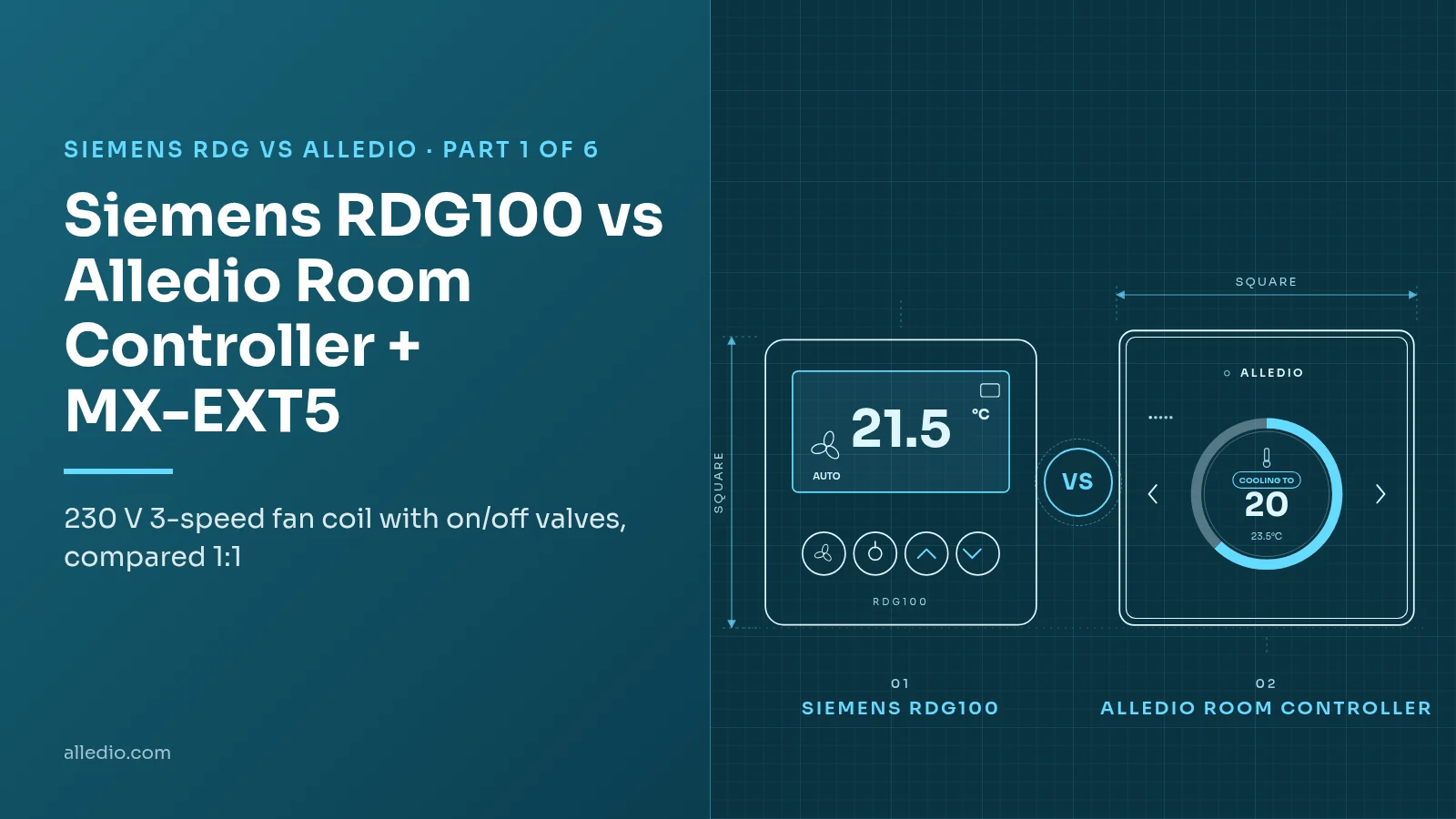
The Siemens RDG100 is one of the most specified wall thermostats for fan coils in Europe: a 230 V unit that switches a three-speed fan and two on/off valves, with no bus. This article rebuilds the same job on the Alledio Room Controller plus the Relay MX Extender MX-EXT5, so you can see what stays the same and what changes.
Part 1 of 6 in our Siemens RDG/RDF vs Alledio series. Each part takes one Siemens model and rebuilds the same application on Alledio.
Fan Coil230 V3-SpeedOn/Off ValvesModbus RTUOEM
The short answer
- Same job: three fan speeds plus a heating and a cooling valve, or one change-over valve on 2-pipe units.
- Alledio setup: Room Controller RC-TH-1 or RC-TH-2 plus MX-EXT5 in Mode 1. Fan speeds on O1–O3, heating valve on O4, cooling valve on O5.
- Biggest difference: the RDG100 has no bus. Alledio adds Modbus RTU to the BMS, and keeps mains voltage out of the wall box.
- Where Siemens leads: a very well-known product with a proven DIP-switch setup, 3-position and PWM valve outputs, and a timer version (RDG100T).
- Where Alledio leads: Modbus RTU, a 3.5" touchscreen, humidity as standard, 5 A relays at the load, over-the-air updates and full OEM customisation.
Siemens RDG100 vs Alledio at a glance
| Feature | Siemens RDG100 (230 V) | Alledio Room Controller + MX-EXT5 |
|---|---|---|
| Devices | 1 wall unit | Wall unit + DIN-rail relay module |
| Mains at the wall | Yes, AC 230 V | No, 24 V and one Modbus pair |
| Fan outputs | Q1–Q3, AC 230 V, 5 mA…5(4) A | 3 NO on the MX-EXT5, 5 A at 250 V AC resistive, interlocked |
| Valve outputs | Y1–Y4, AC 230 V, 8 mA…1 A: on/off, PWM or 3-position | 2 NO on the MX-EXT5, 5 A at 250 V AC resistive: on/off |
| Bus to the BMS | None | Modbus RTU |
| Display | Backlit LCD with push buttons | 3.5" capacitive touchscreen |
| Humidity | Not measured | Standard |
| Custom versions | Standard Siemens range | Full OEM: brand, UI, firmware, sensors, from 1,000 pcs |
What the Siemens RDG100 does
According to Siemens datasheet CE1N3181en (RDG1.. wall-mounted room thermostats with LCD, issue 6 June 2023), the RDG100 is a 230 V room thermostat for fan coil units, chilled or heated ceilings and compressor-based equipment. The application is chosen with DIP switches at the back of the unit. These are the points that matter for a fan coil:
- Fan outputs: Q1, Q2 and Q3 at AC 230 V, rated 5 mA to 5(4) A, for a 1-speed or 3-speed fan. Fans must not be connected in parallel.
- Valve outputs: Y1 to Y4 at AC 230 V, 8 mA to 1 A, on/off, PWM or 3-position, protected by a 3 A fast microfuse that cannot be exchanged.
- Supply: AC 230 V, 50/60 Hz, max. 8 VA / 1 W, with an external C 10 A circuit breaker required.
- Inputs: three multifunctional inputs (X1, X2, D1) for a key card contact, an external NTC sensor, a change-over sensor, a dew point sensor or a fault signal.
- Sensor: built-in temperature sensor, accuracy below ±0.5 K at 25 °C, range 0–49 °C. No humidity measurement.
- Housing: white (RAL 9003) plastic, IP30, 0.30 kg.
The RDG100T adds an infrared receiver and an auto timer with 8 programmable timers. The RDG110 uses relay outputs and the RDG160T family works at 24 V with DC 0–10 V and ECM fan support. None of them has a bus interface, so the room thermostat stays an island next to your BMS.
The Alledio configuration that covers the same job
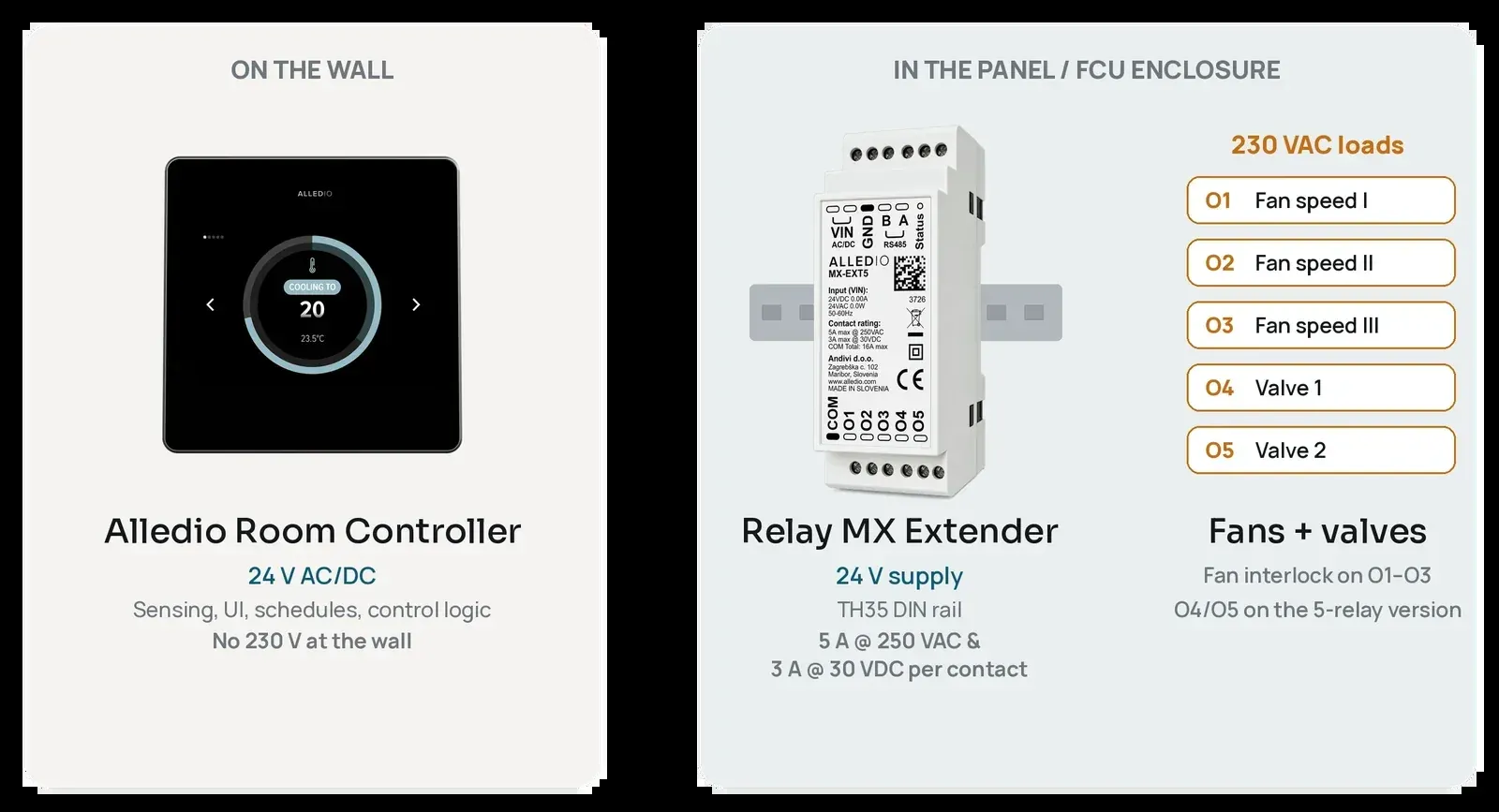
Alledio splits control and power into two devices. Together they are sold as the Alledio Thermostat: a Room Controller on the wall and a Relay MX Extender next to the fan coil. The Room Controller does the sensing, the touch interface, the schedules and the control logic. The MX-EXT5 switches the 230 V loads.
Parts list
| Part | Role | Setting for this use case |
|---|---|---|
| Alledio Room Controller RC-TH-1 or RC-TH-2 | On the wall: temperature and humidity sensing, touch UI, schedules, control logic, Modbus to the BMS | RC-TH-1 has 1 universal output and 1 universal input. RC-TH-2 has 2 of each and covers a change-over sensor and a window contact |
| Relay MX Extender MX-EXT5 | On the DIN rail at the fan coil: switches the 230 V fan and valves | Mode 1 (fan coil), which is the factory default |
The codes are the ones shown in the Alledio Use Case Simulator. RU is the Room Unit, RC the Room Controller, TH means temperature and humidity, THC adds CO₂ and the last digit is the number of universal outputs.
| Code | Device | Sensors | Local I/O |
|---|---|---|---|
| RU-TH-0 | Room Unit | Temperature, humidity | None |
| RC-TH-1 / RC-THC-1 | Room Controller | T + RH (THC: + CO₂) | 1 universal output, 1 universal input |
| RC-TH-2 / RC-THC-2 | Room Controller | T + RH (THC: + CO₂) | 2 universal outputs, 2 universal inputs |
| RC-TH-3 / RC-THC-3 | Room Controller | T + RH (THC: + CO₂) | 3 universal outputs, 2 universal inputs, 1 universal input/output |
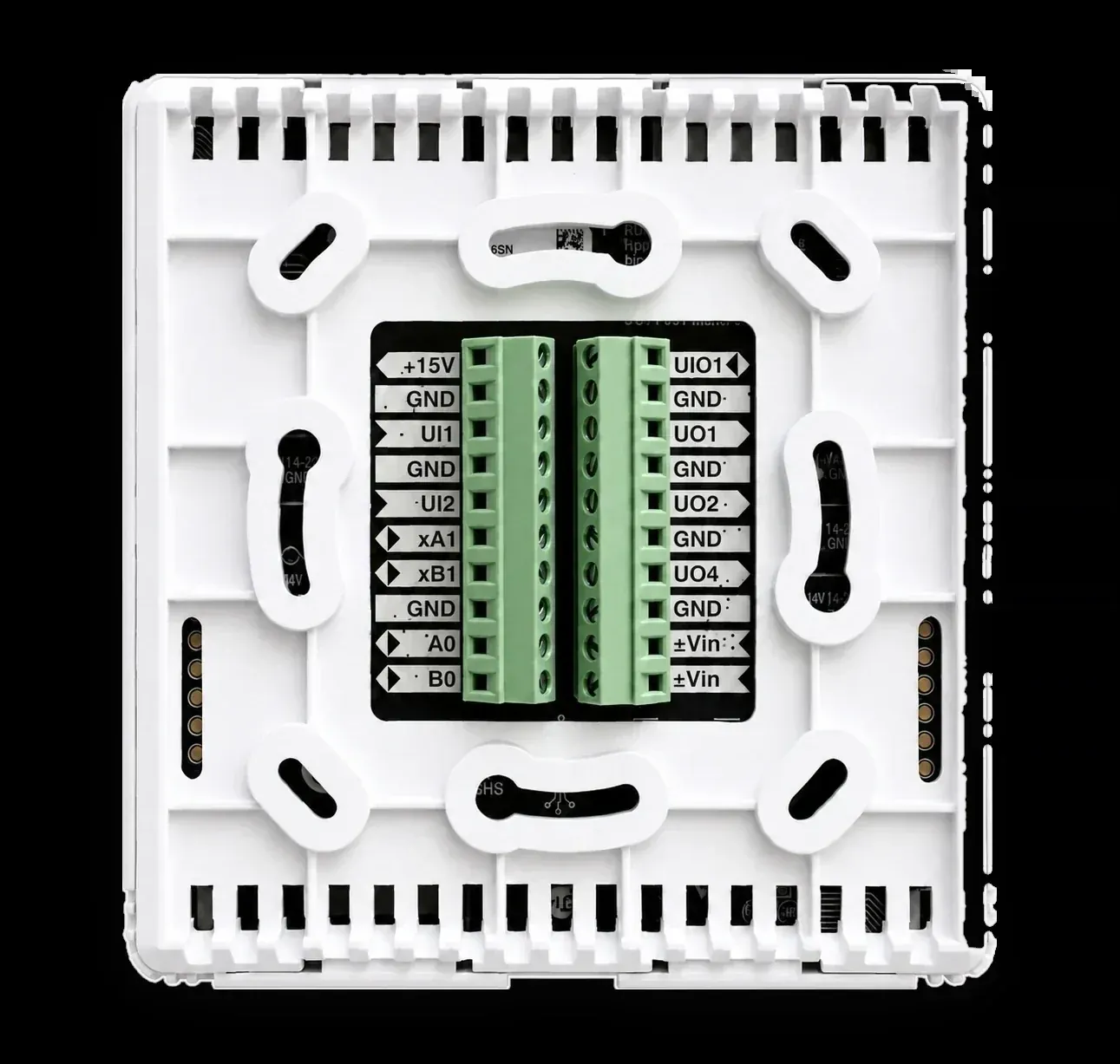
The Room Controller never sees mains voltage: it runs on 18–42 V DC or 24 V AC ±25 %, with 24 V recommended. The MX-EXT5 runs on the same 24 V. It connects to the wall device's secondary Modbus port A1/B1 (terminals 5/6), while the primary Modbus port A0/B0 (terminals 8/9) stays free for the building management system. The MX-EXT5 ships in Mode 1 at Modbus address 8, 9600 baud 8N1 by default, configurable up to 115200.
Output mapping: Siemens RDG100 vs Alledio
| Function | Siemens RDG100 | Alledio Room Controller + MX-EXT5 |
|---|---|---|
| Fan speed 1 / 2 / 3 | Q1 / Q2 / Q3 (5(4) A) | MX-EXT5 O1 / O2 / O3 (5 A) |
| Heating valve | Y1–Y4 (max. 1 A), per DIP setting | MX-EXT5 O4 (5 A) |
| Cooling valve | Y1–Y4 (max. 1 A), per DIP setting | MX-EXT5 O5 (5 A) |
| Change-over sensor | X2 (NTC) | Room Controller UI1 or UI2 |
| Key card / window contact | D1 | Room Controller UI1 or UI2 (volt-free contact) |
| BMS bus | None | Primary Modbus A0/B0 (terminals 8/9) |
| Power | AC 230 V at the wall | 24 V AC/DC at the wall and at the MX |
The MX-EXT5 contacts are rated 5 A at 250 V AC resistive, with up to 16 A through the shared COM. All loads on that COM must be in one voltage band. The outputs are not fused, so fit an MCB or fuse matched to the load, max. 5 A per Ox output. In Mode 1 the firmware interlocks O1–O3 so that only one fan speed is ever closed. As the datasheet says, that interlock is an application function, not a safety function.
Two details to check if you convert an existing RDG100 design. First, the RDG100 takes NTC 3k sensors as printed in the Siemens datasheet, while an Alledio universal input reads an NTC 10k, so an existing change-over sensor may have to change. Second, Alledio universal inputs accept up to 30 V and are not isolated, so use a volt-free contact for a key card or window.
Valve types: on/off, PWM and 3-position
The RDG100 can also drive PWM thermal actuators and 3-position (floating) actuators. On Alledio, the standard fan coil mode drives on/off valves on O4 and O5. For thermal actuators, the MX-EXT5 is relay based, so its contacts allow a limited number of switching cycles (100,000 electrical operations at 5 A, 250 V AC resistive). We suggest a shortest switching period of 1 mHz, about one cycle every 16 minutes. For fast modulation use a 0–10 V actuator on a Room Controller universal output. If your design needs 3-position actuators, talk to us about the relay layout before you commit.
On a 2-pipe unit with one change-over valve the setup stays the same, with O4 driving the valve. For more on this split, read our article on a 3-speed fan coil thermostat with a Modbus relay extender.

For the full wiring of a three-speed fan on Alledio, read our guide to the 3-speed AC fan coil thermostat with Modbus.
Siemens RDG100 vs Alledio: specifications side by side
| Topic | Siemens RDG100 | Alledio Room Controller + MX-EXT5 |
|---|---|---|
| Supply | AC 230 V, 50/60 Hz | Room Controller: 18–42 V DC or 24 V AC ±25 %, 24 V recommended. MX-EXT5: same |
| Power consumption | max. 8 VA / 1 W | Controller 0.3 W (50 % brightness); MX 0.2 W with contacts open, 1.5 W max. |
| Fan outputs | 3 outputs, AC 230 V, 5 mA…5(4) A | 3 NO on the MX, 5 A at 250 V AC resistive, interlocked |
| Valve outputs | AC 230 V, 8 mA…1 A, on/off, PWM, 3-position | 2 NO on the MX, 5 A at 250 V AC resistive |
| Inputs | 3 multifunctional (X1, X2, D1) | RC-TH-2: 2 universal inputs. RC-TH-3: UI1, UI2 + UIO1 |
| Display | Backlit LCD, push buttons | 3.5" capacitive touchscreen, 480 × 320 px, automatic brightness |
| Temperature accuracy | < ±0.5 K at 25 °C | ±0.5 °C average (0–60 °C) |
| Humidity | No | Standard, ±1.8 % (10–90 % at 25 °C) |
| Bus options | None | Modbus RTU (client or server), Wi-Fi (station mode), MQTT; BACnet as custom firmware |
| Configuration | DIP switches and parameter menu | Every installer parameter on the touchscreen; Use Case Simulator with installer PDF for partners |
| Firmware updates | Not applicable | Over-the-air via Wi-Fi |
| Protection | IP30 | Controller IP30; MX IP30 as installed in an enclosure |
| Size | Wall unit, 0.30 kg | Controller 98 × 98 × 23 mm, EU flush box Ø 60 mm |
Siemens values from datasheet CE1N3181en (6 June 2023). Alledio values from the Room Controller and Relay MX Extender datasheets. Always check the current datasheets for your project.
What matches and what differs
For the basic fan coil job both setups do the same thing: they read the room temperature, pick one of three fan speeds and open a heating or cooling valve. The control strategy is comparable, so a design that works with the RDG100 maps to Alledio output by output.
What differs is architecture. The RDG100 is one device that carries mains and five switched lines to the wall box. Alledio puts only 24 V and one Modbus pair in the wall, and the relays sit next to the loads. That shortens the cable run for 230 V and makes the wall box a low-voltage place.
The other difference is the bus. Siemens has other models with a bus, but the RDG100 itself has none. With Alledio the same wall unit reports temperature, humidity and setpoint to the BMS and accepts setpoints and modes back, which makes it a commissioning and monitoring tool as well as a thermostat.
Commissioning and integration
On the RDG100 the application is selected with DIP switches before fitting, and commissioning parameters are set in the thermostat. On Alledio every installer parameter is set on the touchscreen itself, from Modbus address to fan behaviour. Firmware can be updated over the air via Wi-Fi.
The MX-EXT5 is configured over Modbus: mode, slave address, motor interlock and bus termination. Devices ship at address 8, so commission them one at a time. The Use Case Simulator in the Partner Hub generates an installer PDF for each setup.
Design, simplicity and OEM flexibility
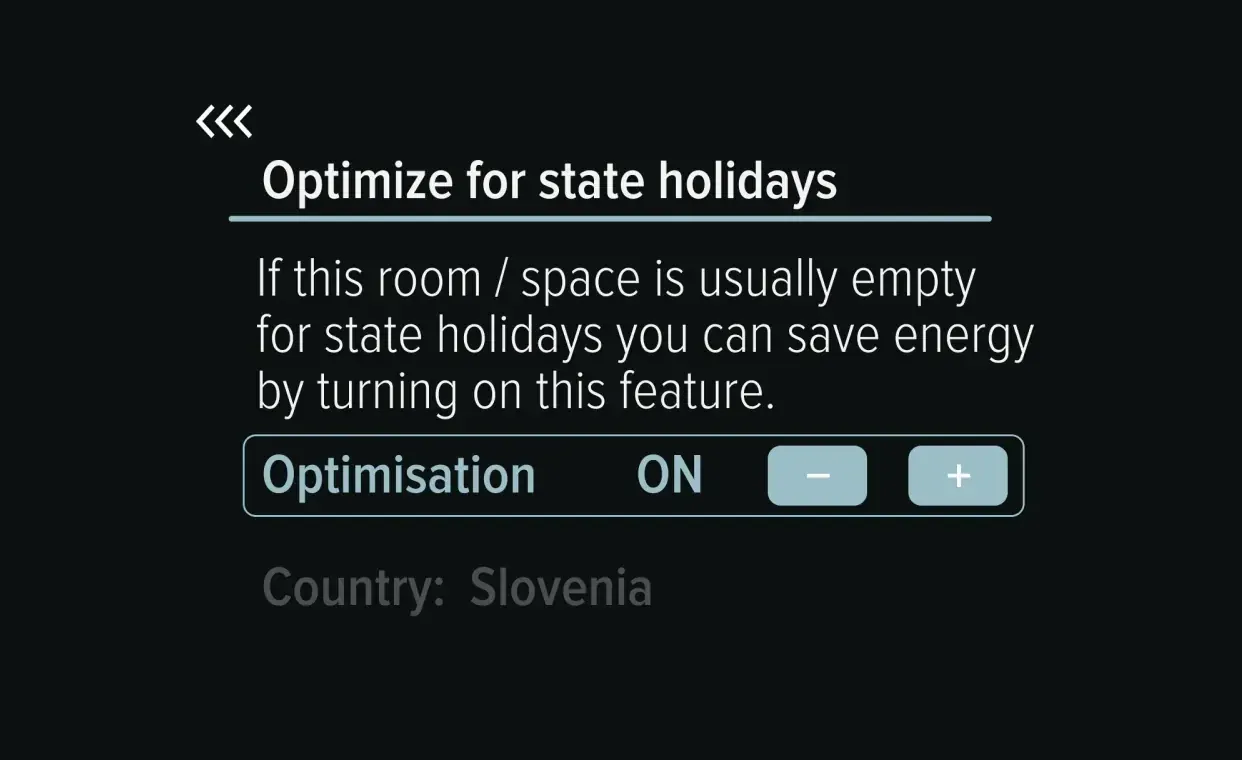
The RDG100 is a standard Siemens product in a fixed design. The Alledio Room Controller is built for manufacturers, so the user interface can be customised: your brand, your screens and your firmware behaviour. An example is an energy optimisation screen for public holidays.
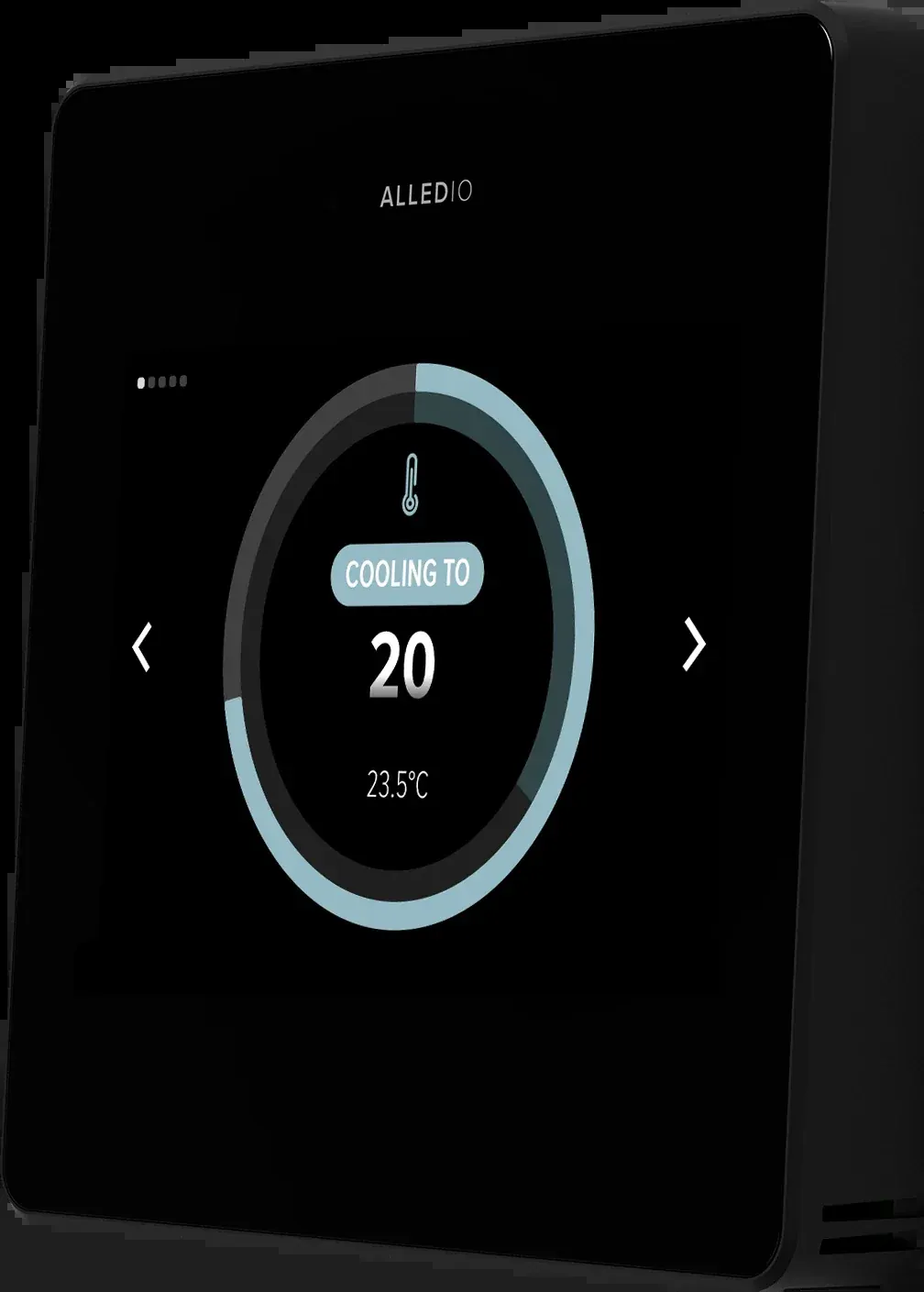
The MX-EXT5 can be mounted and pre-wired on a DIN rail inside the fan coil at the factory. Then only 24 V and one Modbus pair run to the wall. If you want to see what is possible, explore our OEM options below.
Who should choose which
- Choose the Siemens RDG100 if you want a stand-alone, proven thermostat in a Siemens-specified project, with no BMS connection and standard 230 V wiring at the wall.
- Choose Alledio if you manufacture fan coils and want a Modbus-connected, brandable controller, with low-voltage wiring in the wall and the relays at the unit.
- Choose Alledio with an RC-TH-2 if you need a change-over sensor and a window or key card contact at the wall.
Siemens RDG100 vs Alledio FAQ
Is the Siemens RDG100 a Modbus thermostat?
No. The RDG100 has no bus interface. If you need Modbus RTU, the Alledio Room Controller with an MX-EXT5 covers the same fan coil job and reports to the BMS.
What does the Alledio setup need to replace an RDG100?
An Alledio Room Controller RC-TH-1 or RC-TH-2 on the wall and an MX-EXT5 in Mode 1 at the fan coil. Fan speeds go on O1–O3, the heating valve on O4 and the cooling valve on O5.
Can the Alledio Room Controller switch a 230 V fan directly?
No. The Room Controller runs on 18–42 V DC or 24 V AC ±25 %, and its universal outputs are 0–10 V (max. 20 mA), 4–20 mA or open-collector digital. 230 V fan speeds and valves are switched by the MX-EXT5 at up to 5 A per contact.
Can I reuse the NTC sensor from an RDG100 installation?
Check the sensor type first. The Siemens datasheet lists an NTC 3k input, while an Alledio universal input reads an NTC 10k.
Does Alledio support 3-position or PWM valve actuators like the RDG100?
The standard fan coil mode drives on/off valves. PWM on the MX-EXT5 relays is limited to slow periods, about one cycle every 16 minutes, so use a 0–10 V actuator for fast modulation. For 3-position actuators, contact us before you design the relay layout.
Does the Alledio setup work on 2-pipe fan coils?
Yes. On a 2-pipe unit the change-over valve goes on O4 of the MX-EXT5, and the fan speeds stay on O1–O3.
Does the Alledio Room Controller fit a standard wall box?
Yes. It fits a standard EU flush box (Ø 60 mm).
Can installers buy the Alledio Room Controller?
No. Alledio is supplied only to manufacturers that bundle it with their own HVAC equipment, with an MOQ from 1,000 pieces.
What to do next
The Siemens RDG100 and the Alledio Room Controller + MX-EXT5 solve the same fan coil job. Siemens does it in one proven device without a bus. Alledio keeps mains out of the wall, adds Modbus RTU and gives a manufacturer a touchscreen controller it can brand. If you build fan coils and want the controller to be part of your product, see the Alledio Thermostat, then talk to us about your range.
Related reading
Siemens and RDG are trademarks of Siemens AG. Alledio is not affiliated with Siemens. Specifications are as published on the dates cited and may change. Always check the current manufacturer datasheets for your project.