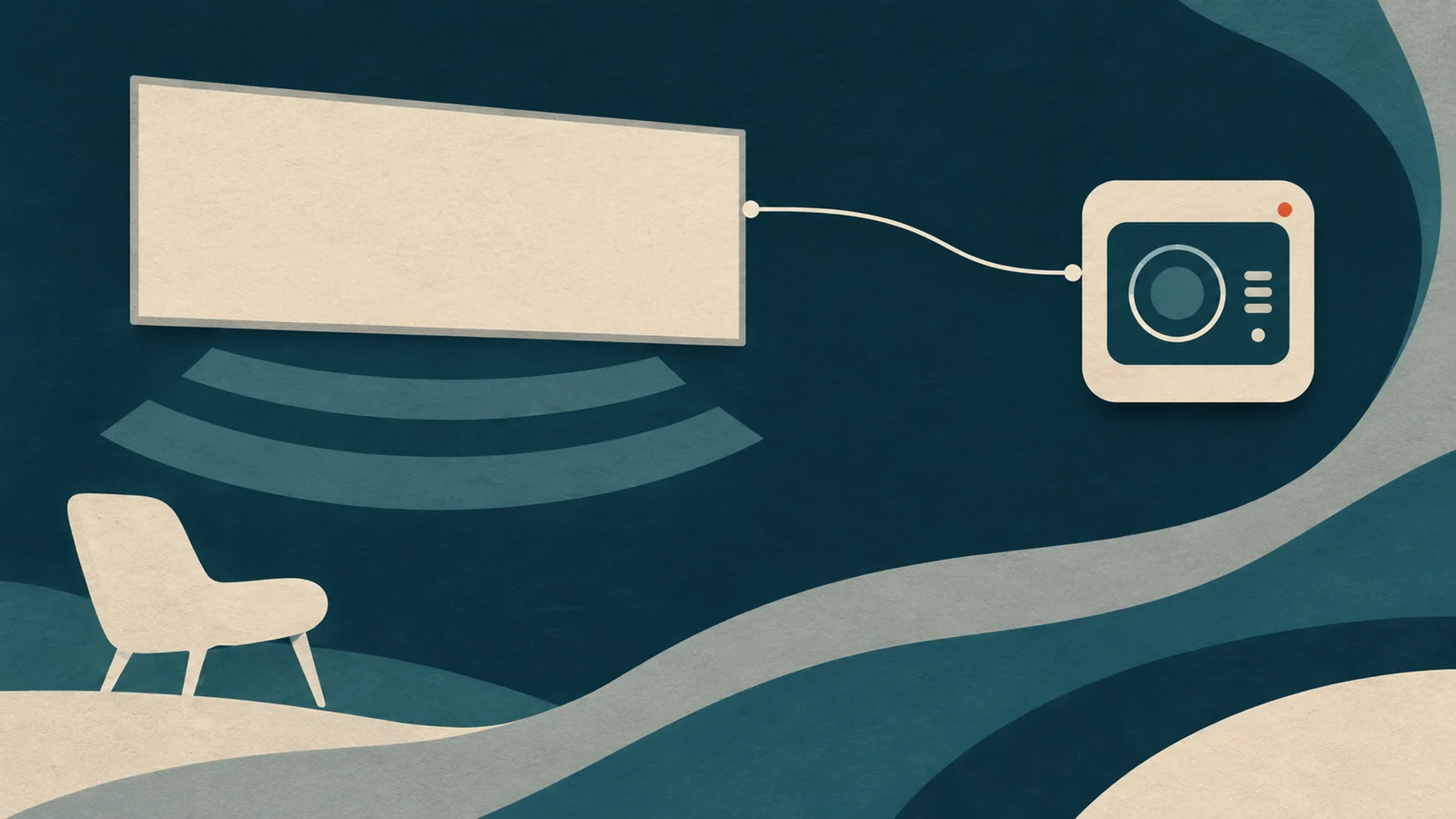
An infrared panel thermostat for an OEM line is not a plug-in dimmer-style device from a DIY shelf. It is the wall unit that carries your brand, reads the room, and tells the heater when to run. Alledio supplies that wall unit as an OEM Room Controller for makers of infrared heating panels, built in Slovenia for programmes of volume.
OEMRoom ControllerHeatingModbusWhite LabelHVAC
What an infrared panel thermostat should do on an OEM line
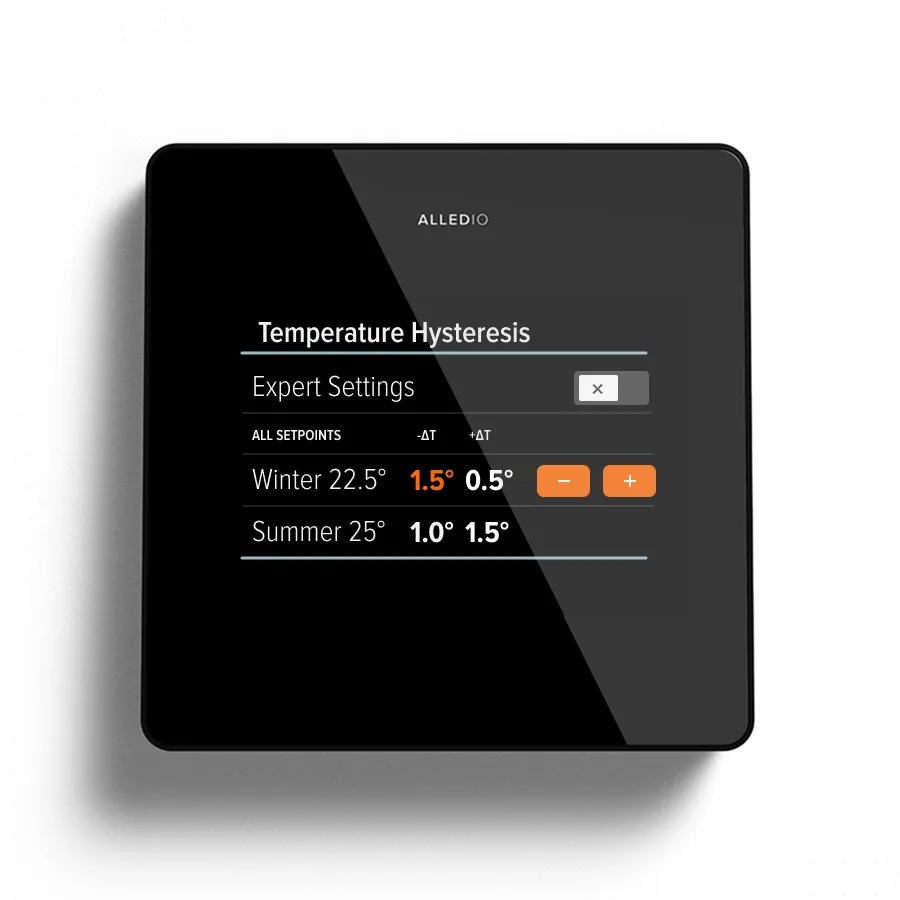
Infrared panels warm surfaces and people rather than air, so users judge comfort by how fast the room feels right. The wall device still has to deliver a few basic duties reliably: read room air temperature, hold a setpoint with a sensible hysteresis, follow a schedule and protect against frost.
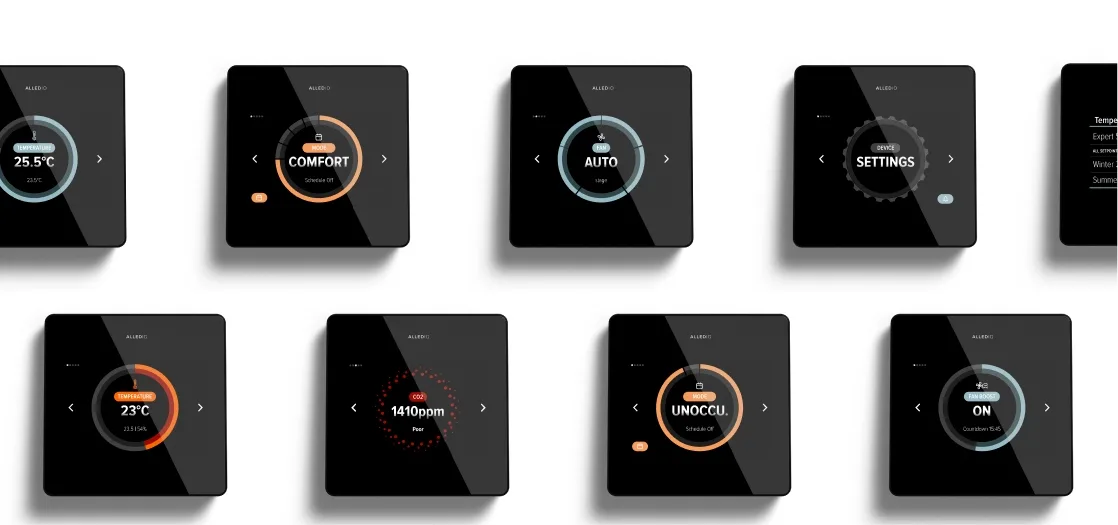
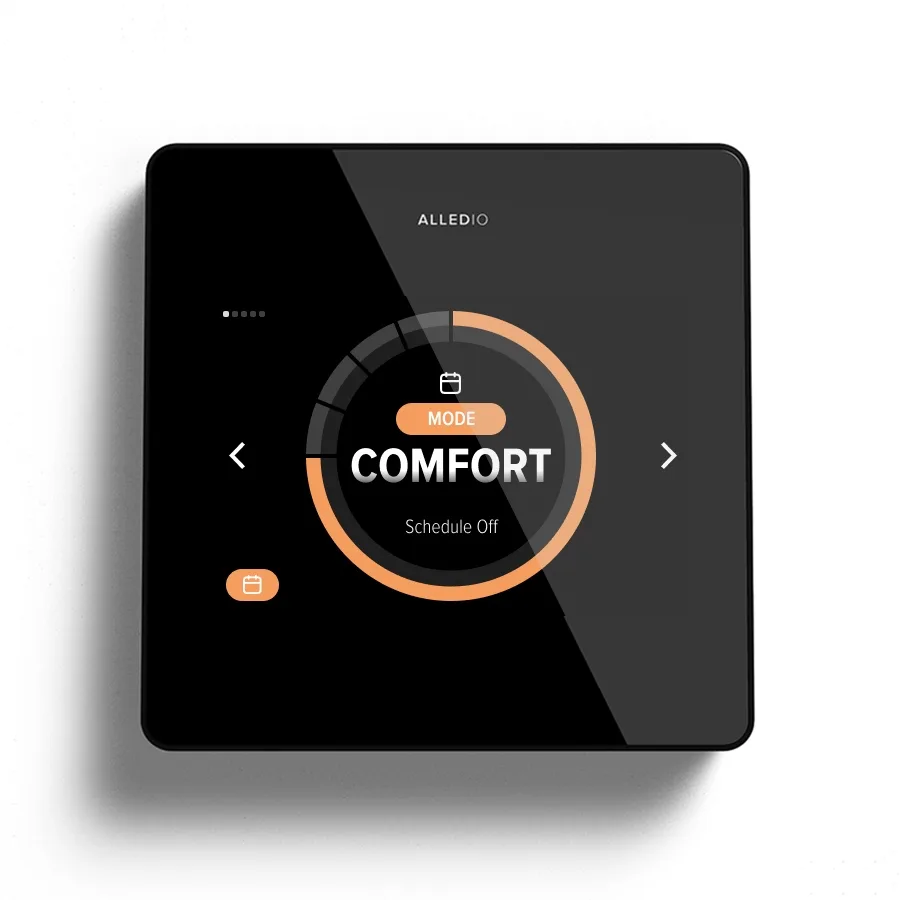
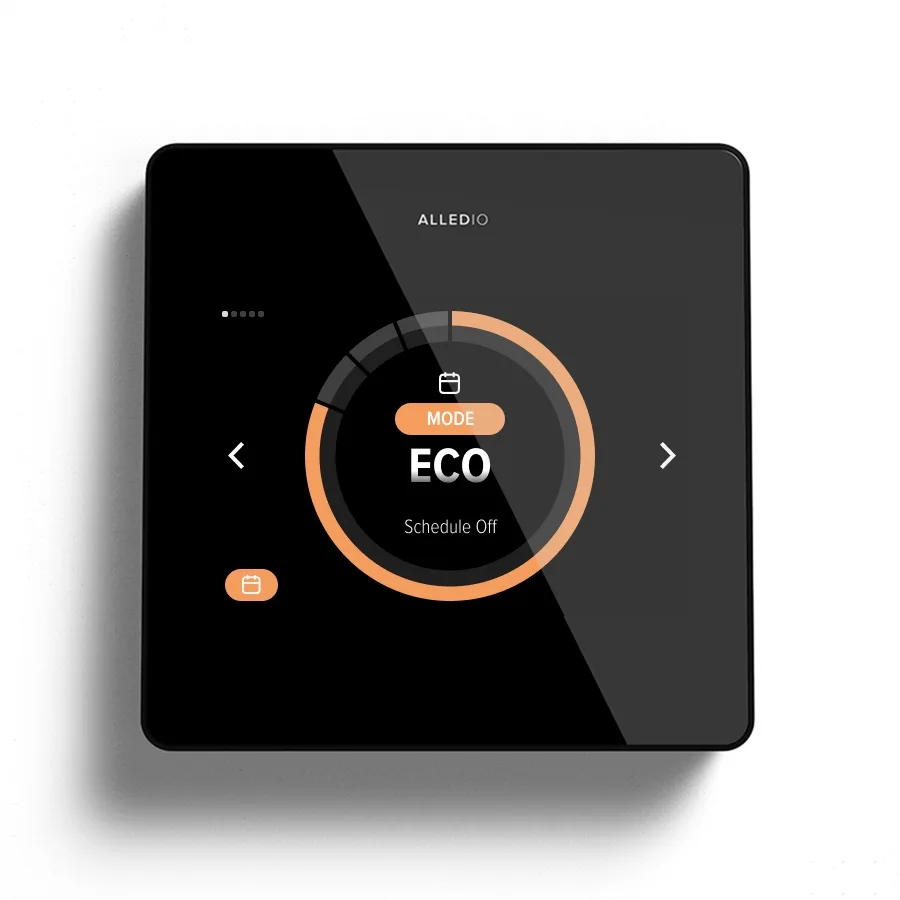
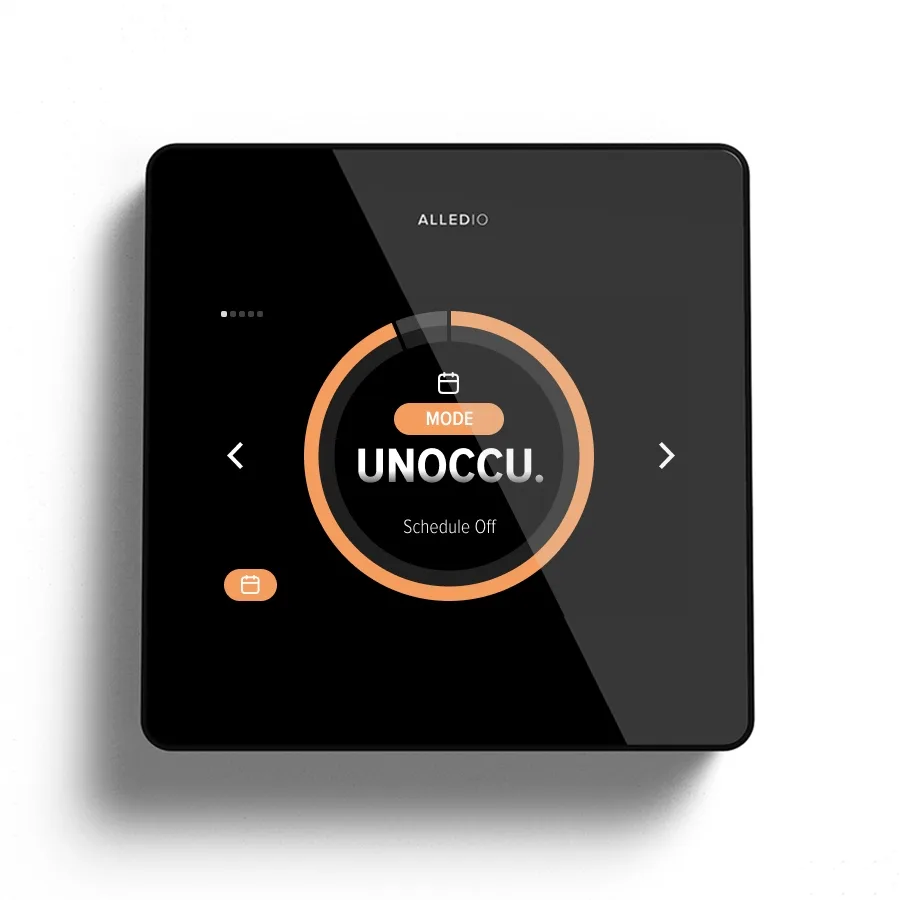
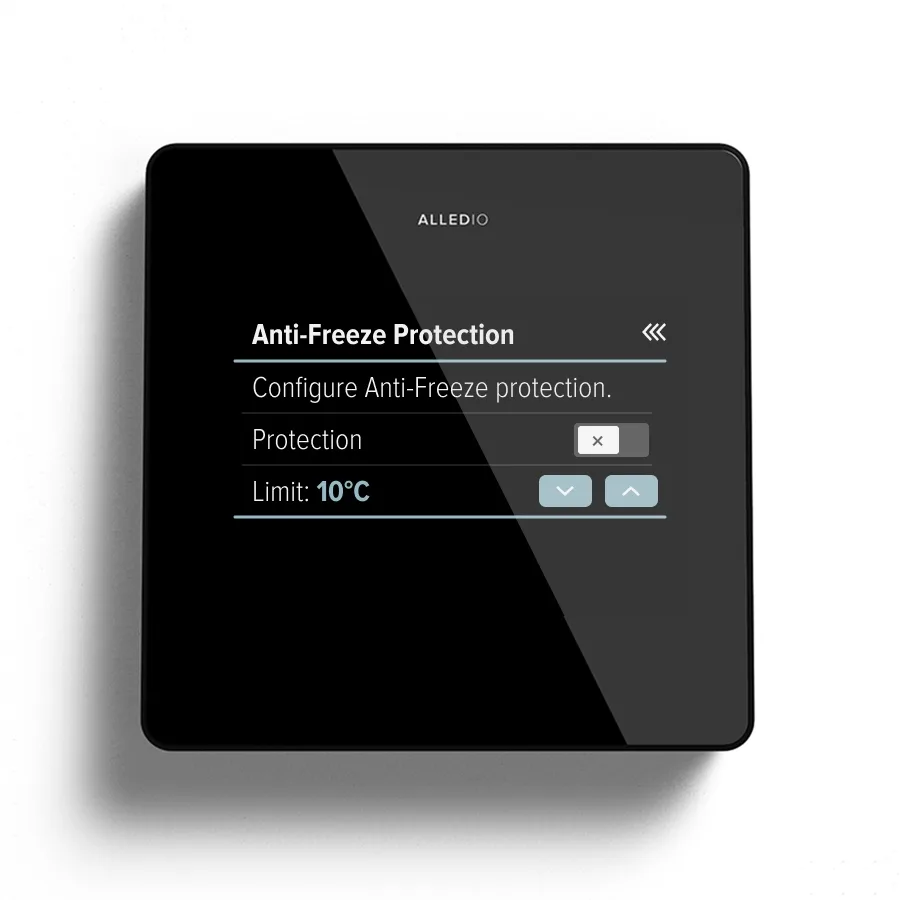
The Alledio Room Controller already offers the screens panel makers ask for: heating mode with a clear setpoint, comfort, eco and unoccupied schedules, hysteresis and anti-freeze settings. Your logo and UI theme sit on top, so the end customer sees your product, not ours.
Keep one limit in view from the start. Alledio ships air temperature and humidity sensing. No black-bulb or radiant-temperature sensor is listed, so an infrared heating panel thermostat built on this platform regulates on air temperature, with the offset and hysteresis tuned for your panel.
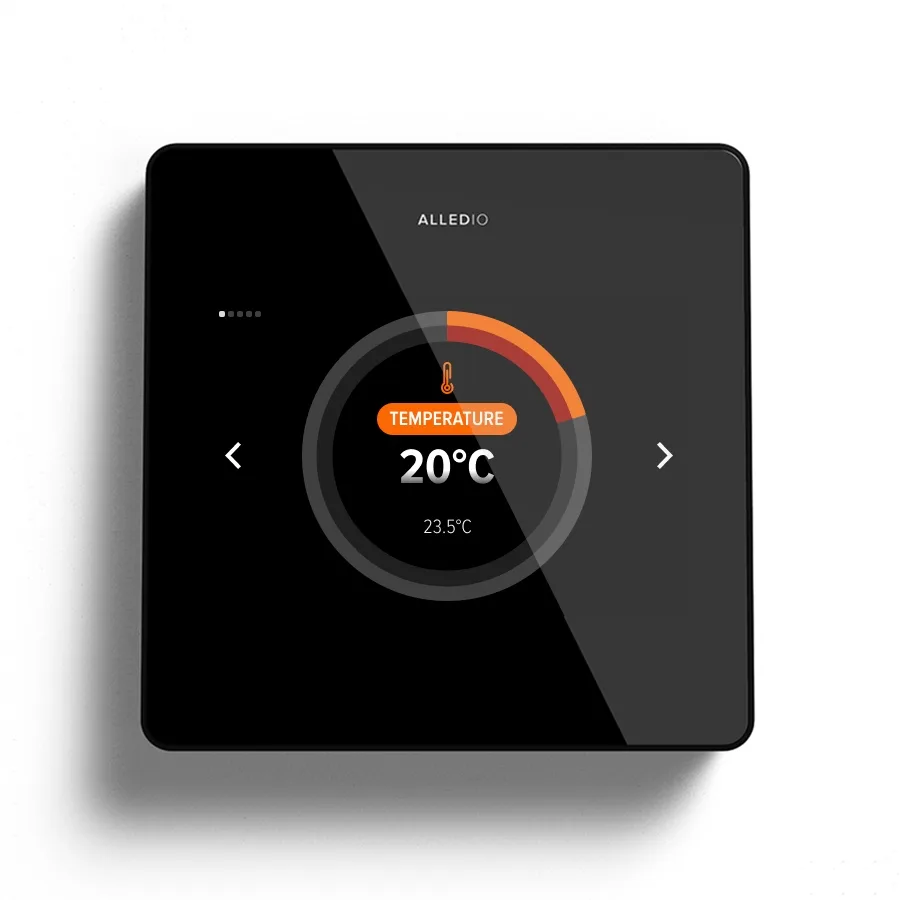
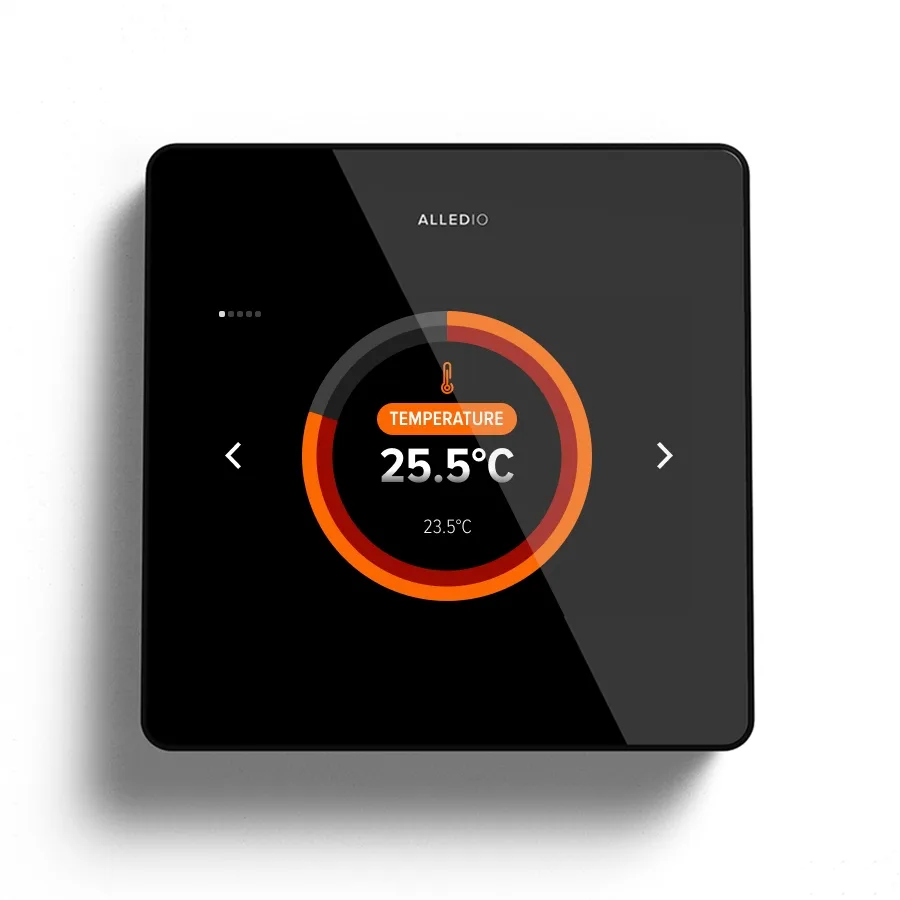
Room Controller or host-driven Room Unit
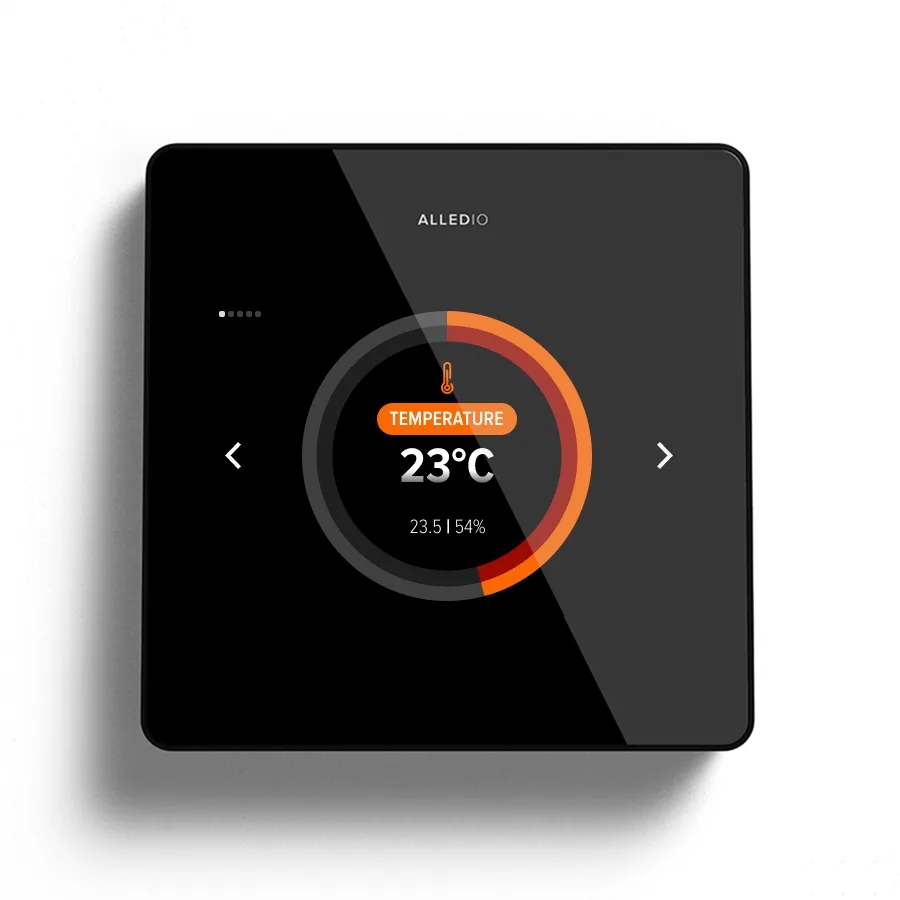
Two Alledio wall devices fit this job. The Room Controller (RC-TH-1/2/3 or RC-THC-1/2/3) has its own inputs and outputs, so the sequence runs on the wall and the panel needs little else. The Room Unit (RU-TH-0 / RU-THC-0) has no plant I/O and is driven by your own host controller over Modbus.
Choose the Room Unit when your panel already has a control board with its own logic and you only want a branded interface. Choose the Room Controller when the wall device should own the heating output. The room unit vs room controller comparison and the room unit vs thermostat guide set out the trade-offs line by line.
Both run from low voltage: the Room Controller takes 18 to 42 V DC or 24 VAC ±25 %, and the Room Unit takes 12 to 42 V DC or 24 VAC ±25 %, with 24 V recommended for both. That is a cabinet-side decision: a small 24 V supply inside or beside the panel feeds the wall device through a thin cable.
How the load is switched
This is the section that decides whether the design is safe, so read it before you read the datasheet. Alledio is an OEM room unit or room controller, not a 16 A plug-in infrared thermostat, and the 230 V panel is never wired to the wall unit.
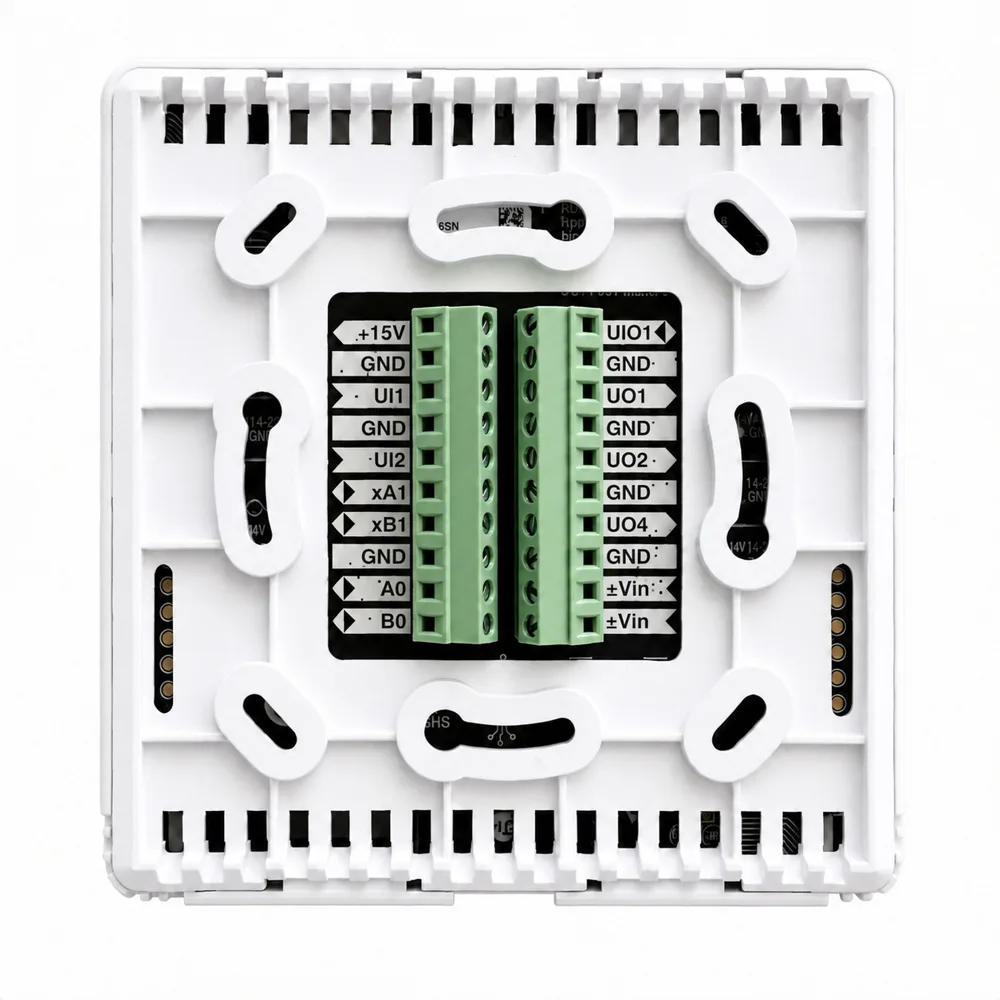
The rear photo is a TH-3 unit (3 UO, 2 UI, 1 UIO). It shows the terminals your engineers will wire: inputs UI1 and UI2, the universal channel UIO1, outputs UO1, UO2 and UO3 (terminal 17), and the supply pair. The outputs are low-voltage signals. They pilot a switching element in the panel cabinet and do not carry mains.
For the switching element, the optional Relay MX Extender MX-EXT5 adds relay contacts on the second Modbus port. One MX-EXT5 contact is rated 5 A at 250 V AC resistive; that rating applies at make, carry and break. At 230 V that is 1150 W on a purely resistive load. Treat about 1000 W as a conservative working ceiling, and use a contactor for anything larger or if the panel's inrush can exceed 5 A. A 1200 W panel already draws about 5.2 A in steady state.
Any panel above that limit, and any multi-panel group, needs a contactor. The Room Controller output then pilots the coil of the contactor and the contactor switches the panel. Fit an MCB or fuse of at most 5 A per MX-EXT5 output. When outputs share COM, the combined current through COM is max 16 A. Remember the relay contacts give micro-disconnection only and are not a safety isolator.
Do not use the MX relays for PWM or fast time-proportional control on a 230 V infrared load. The contacts are rated for 100,000 electrical operations at 5 A, 250 V AC resistive; we suggest a shortest switching period of about 16 minutes (1 mHz), and slow cycling with hysteresis.
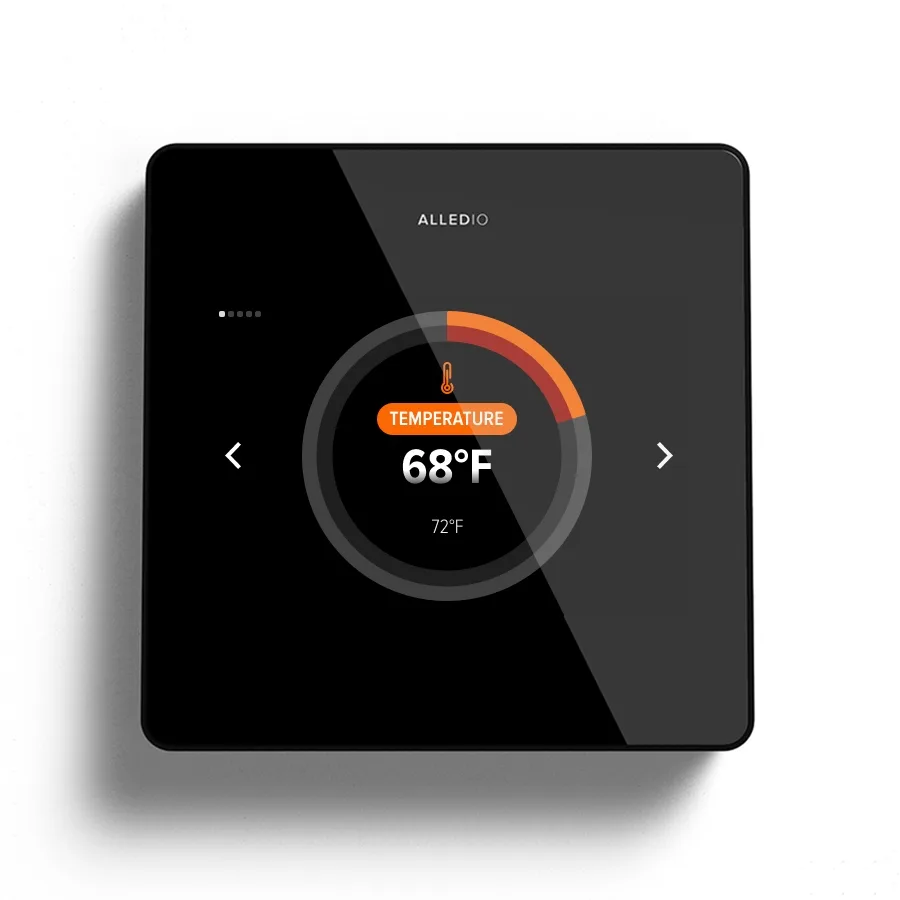
Presence, open window and what stays with the heater maker
Panel makers often ask about presence detection and open-window detection. THCP models have built-in presence detection. Presence and open-window detection are also possible through inputs: an optional presence sensor and a window contact on a UI channel. The behaviour is then defined in the OEM firmware profile that you and Alledio agree.
Do not describe these as declared catalogue functions for Ecodesign. Lot 20, now Commission Regulation (EU) 2024/1103, puts compliance with the heater manufacturer that places the appliance on the market. Alledio never claims Lot 20 certification for a wall unit, and your technical file must show how your complete product meets the regulation.
A single wall unit can also serve several rooms of panels through Modbus. Test your register map on the bench with ModbusMate, a free browser tool, and see the universal I/O guide for how UI, UO and UIO channels combine into one product code.
Three reference setups for infrared panel makers
The right architecture depends on how many panels one wall unit controls and who owns the plant logic. These three patterns cover most briefs we see, and each one keeps mains switching inside the panel cabinet.
Single panel up to about 1000 W (a conservative ceiling under the 5 A resistive rating; 5 A at 230 V is 1150 W). The Room Controller pilots one MX-EXT5 contact on the second Modbus port, and the contact switches the panel directly. Add a 5 A MCB or fuse on the output, slow hysteresis, and an anti-freeze setting for unheated rooms. This is the simplest relay extender layout.
Single large panel or several panels. The Room Controller low-voltage output pilots a contactor sized for the total load, and the contactor switches the panels. Ratings stay on the contactor, and the wall unit remains a 24 V device mounted in a standard EU flush box (Ø 60 mm), about 1.5 m above the floor and away from the panel itself.
Panel with its own control board. The host board keeps the plant logic and the host-driven Room Unit acts as a branded interface over Modbus RTU. Your firmware reads the room values, sets the output and decides how the heater reacts, so no relay logic sits on the wall, and the Modbus multi sensor can add air quality data on the same trunk if the brief asks for it.
In every pattern, write the schedule behaviour, the setpoint limits and the frost protection value into the RFQ, together with the load per panel. Those four lines, plus the supply voltage available in the cabinet, let Alledio match a model and firmware profile before the first sample ships.
Branding, MOQ and samples
Alledio works OEM-only. MOQ is 1,000 pcs and negotiable, and firmware or UI changes are quoted as NRE. The white label room controller article shows how a branded SKU is defined, and the OEM programme page lists what we need from your team.
Samples are purchased and ship with demo or test firmware, so your lab can run heating cycles, schedules and a contactor test before the production firmware and branding are locked. Installers cannot buy one unit: devices reach the market only through the OEM brand that specifies them.
FAQ
Can an installer buy one infrared panel thermostat from Alledio?
No. Alledio sells OEM-only. Installers and integrators receive devices through the OEM brand that specifies them.
Is this a 16 A plug-in infrared thermostat?
No. It is a 24 V OEM wall unit. Mains panels are switched in the cabinet, either within the relay rating or through a contactor.
Can one MX-EXT5 contact switch a 1200 W panel?
No. One contact is rated 5 A at 250 V AC resistive, which is 1150 W at 230 V on a purely resistive load. Treat about 1000 W as a conservative ceiling, and use a contactor if the panel is larger or its inrush can exceed 5 A. A 1200 W panel already draws about 5.2 A in steady state. Pilot the contactor from the Room Controller low-voltage output.
Is Alledio Lot 20 certified?
No such claim is made. Ecodesign and Lot 20, now Commission Regulation (EU) 2024/1103, compliance sits with the heater manufacturer placing the appliance on the market.
Does it support presence and open-window detection?
THCP models have built-in presence detection. Presence and open-window detection are also available through inputs: an optional presence sensor and a window contact on a UI channel, with behaviour defined in the OEM firmware. These are not claimed as declared Lot 20 functions.
What are the MOQ and sample terms?
MOQ is 1,000 pcs and negotiable. Samples are purchased and ship with demo or test firmware for lab validation.
What to do next
List the load per panel, the switching element and the schedule logic in your RFQ, then open the Alledio Room Controller page to match the model. Start an OEM conversation or contact the team for samples with demo firmware and a quote for your oem infrared panel thermostat range.