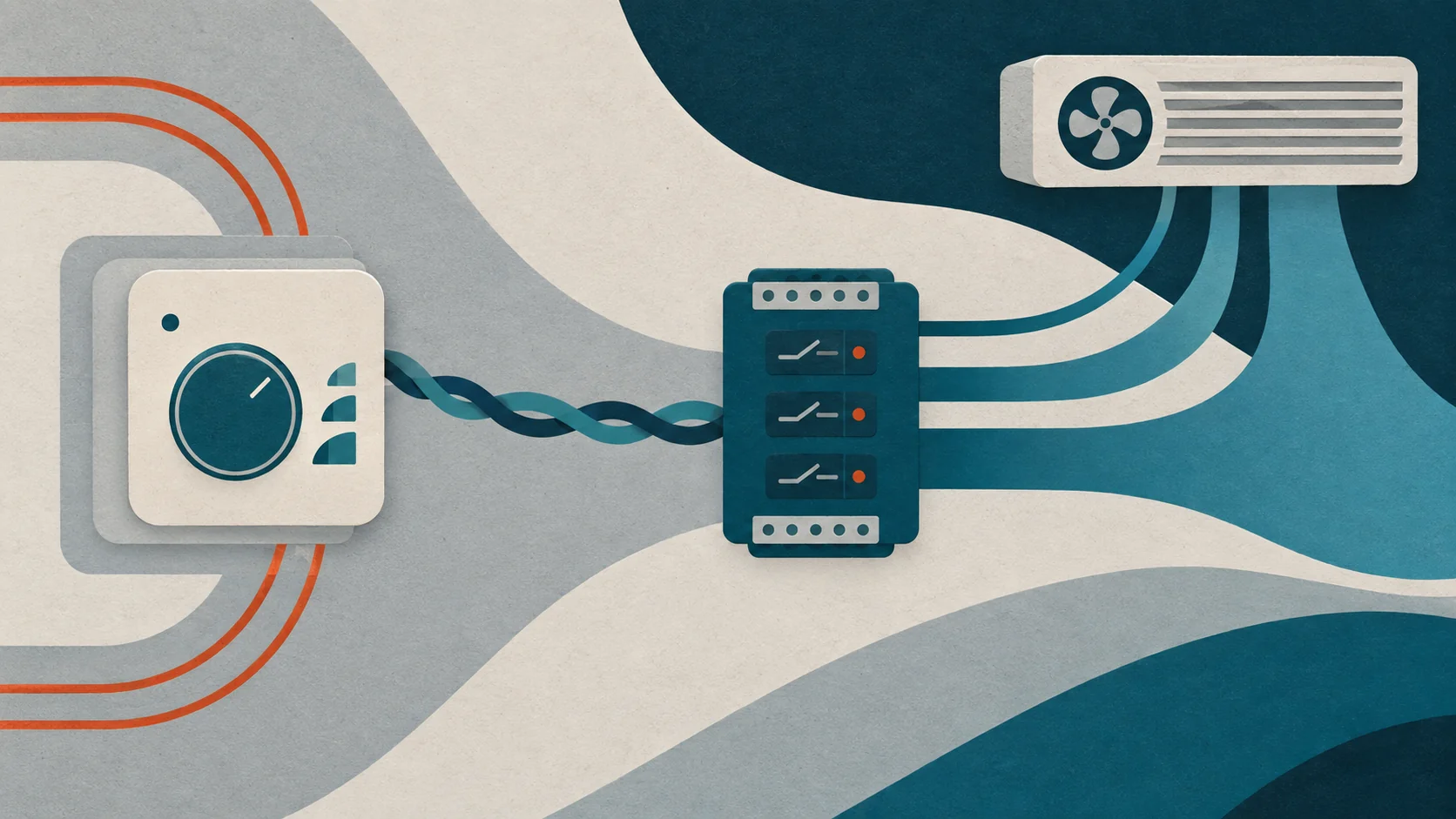
HVAC brands that still ship a third-party wall brick and a separate I/O board lose months in every RFQ. An oem room controller universal I/O puts the glass, the sensors, and configurable inputs and outputs on one flush square - so plant safeties stay on the host you already certify, while the wall face carries your logo and the field wiring your AHU, heat-pump, FCU, VAV, or rooftop line actually needs.
OEMUniversal I/OModbusHVACRoom ControllerWi-Fi
Who this is for
This article is for OEM product managers and BMS device makers who are replacing a third-party room controller on AHU, heat-pump, FCU, VAV, radiant, or rooftop lines - not for installers shopping a webshop.
Alledio's Room Controller is designed and manufactured in Slovenia for high-MOQ OEM programmes. The published commercial model starts at MOQ 1,000 (negotiable). Samples ship with demo or test firmware. Installers and system integrators buy through the OEM channel, not from Alledio direct.
If you only need a host-driven display and sensors without field I/O in the wall, that is the Room Unit. If you need 230 VAC relays for a three-speed FCU, that is the Thermostat family. Keep those SKU splits in the RFQ so purchasing does not mix a display with a controller or a relay thermostat.

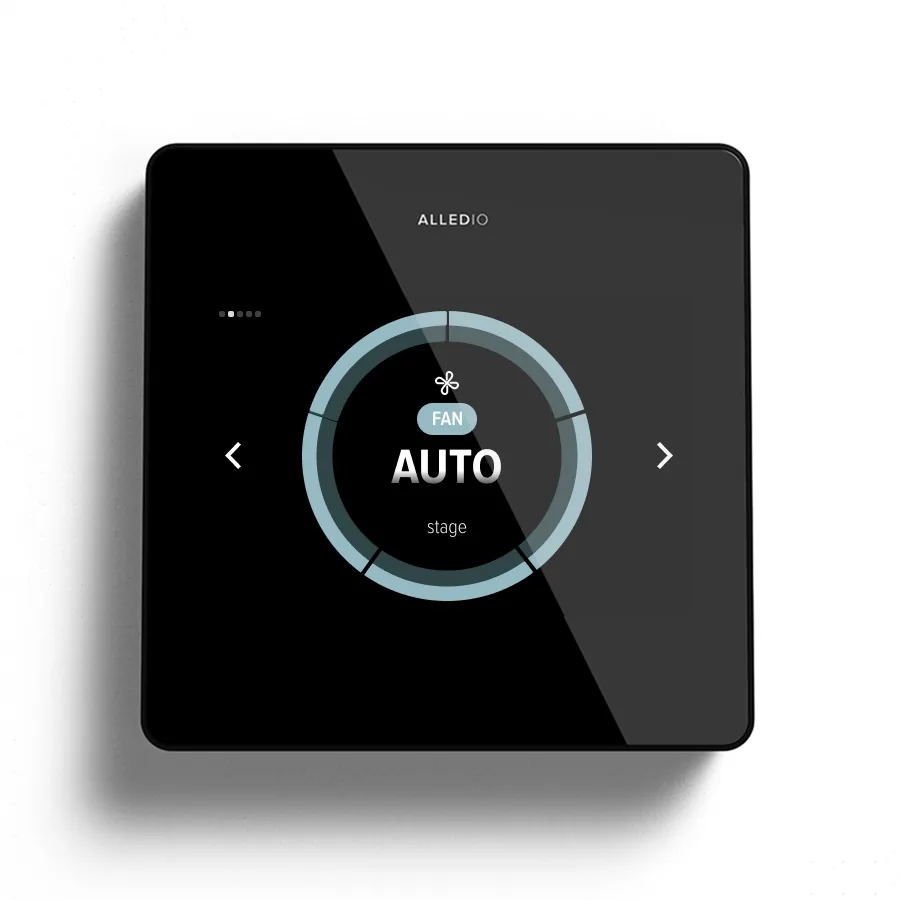
OEM room controller universal I/O — TH versions and max mix
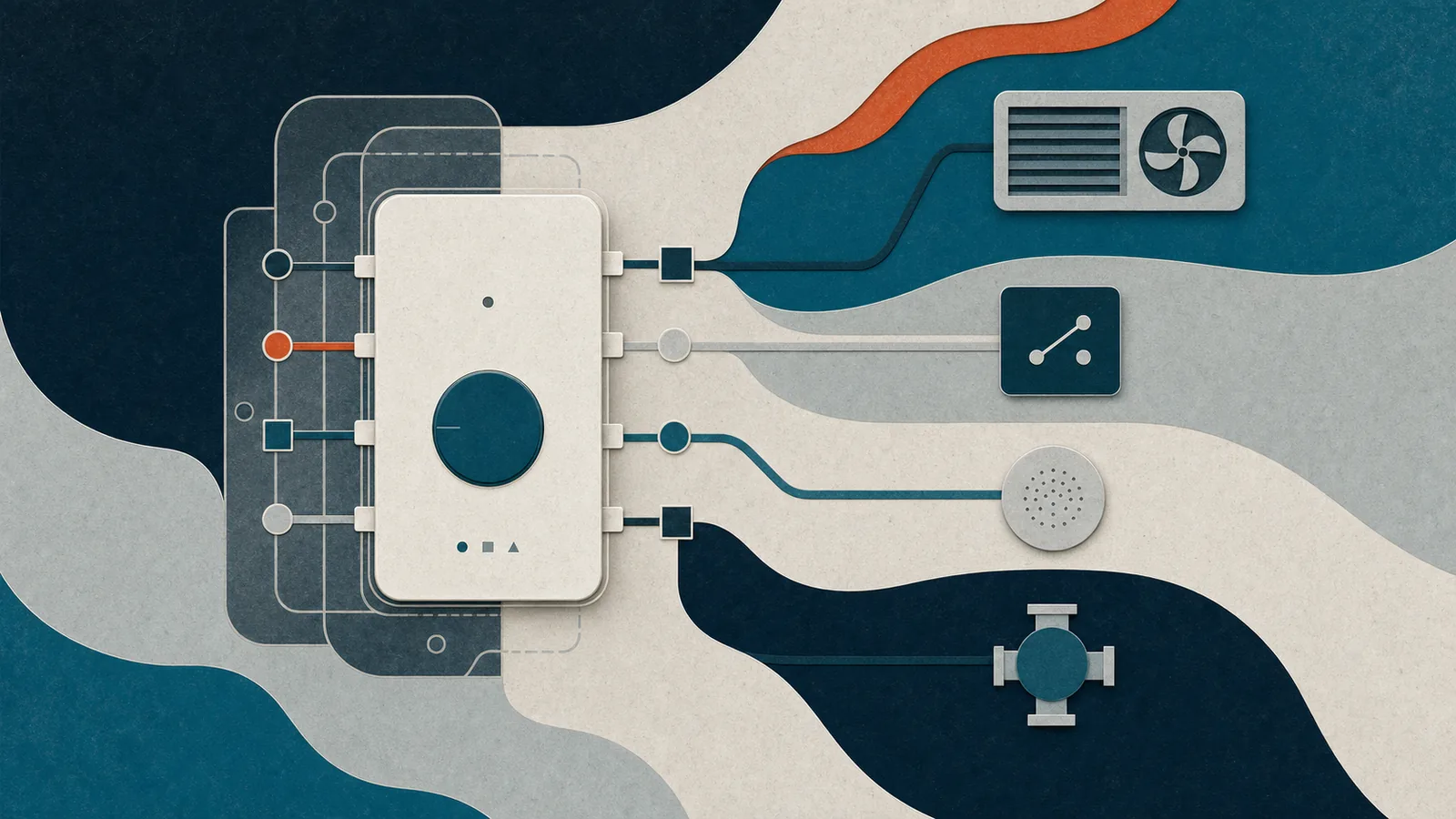
Universal I/O is the reason OEMs pick a controller over a display. On the Alledio Room Controller, the published maximum mix is 2x UI, 3x UO, and 1x UIO, with concrete counts depending on the TH / TH1 / TH2 / TH3 version you order. Write the version and the pin map into the ICD - do not assume every terminal is present on every glass.
Treat the I/O table as a commercial line item. Versions exist so you can order the terminals you need without paying for empty hardware, and so field teams do not invent jumpers that were never validated. A clean RFQ names the version code, the sensor list, and which outputs are analogue versus digital before NRE starts.
I/O classes: UI, UO, and UIO
Universal inputs (UI) take sensors and contacts you already stock - analogue voltage or current, or digital paths - depending on the firmware map you lock. Universal outputs (UO) drive the actuators your plant already expects, often 0-10 V or digital open-collector paths, without forcing a 230 VAC relay thermostat SKU. A UIO channel is the flex pin for programmes that still change the last field wire late in the RFQ.
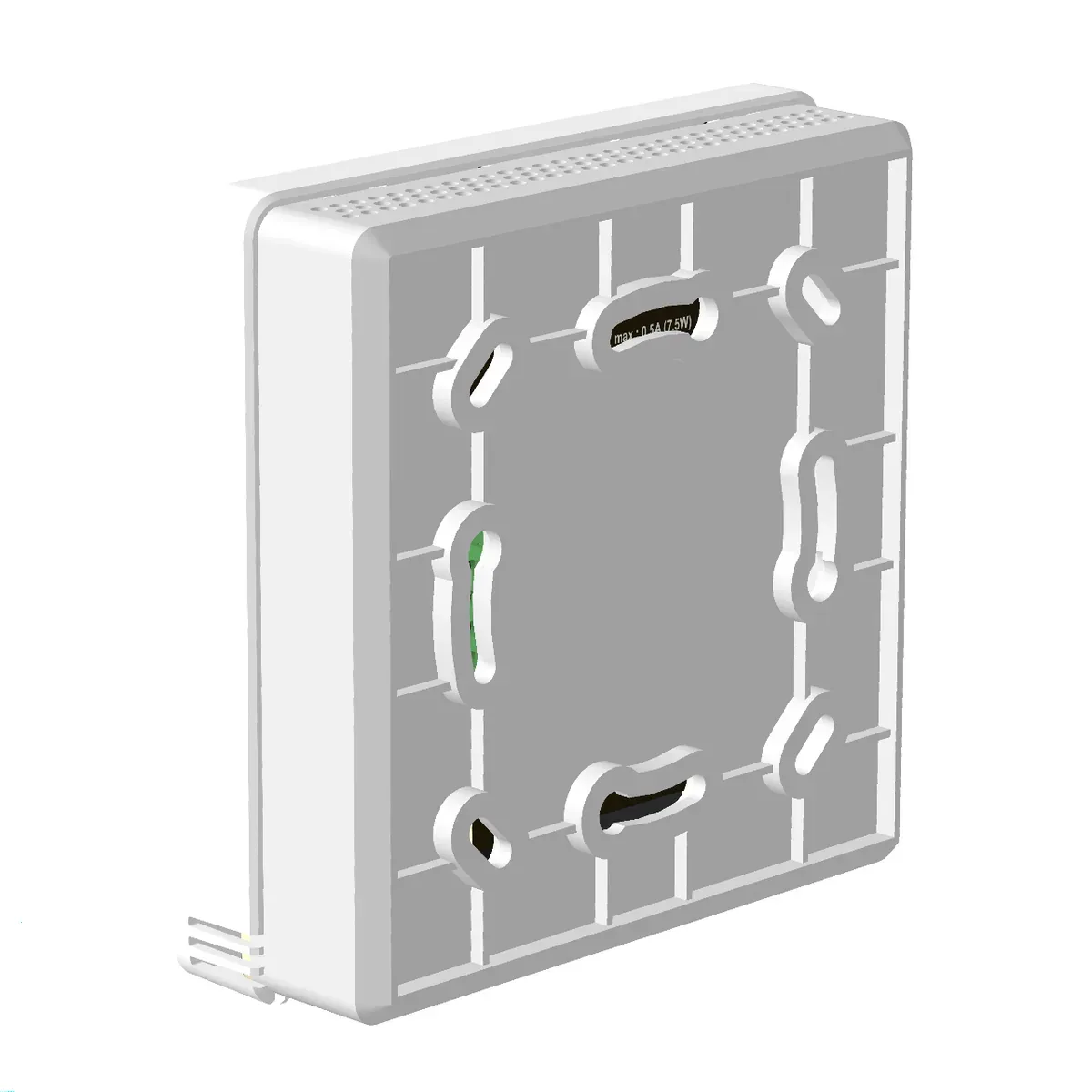
Put the termination, common reference, and cable class next to the pin list. Field teams waste commissioning days when the glass looks finished but the I/O class was never written down. Link the mechanical drawing to the same document that lists Modbus registers and Wi-Fi partner options.
Optional MR5 when you need panel relays (not 230 VAC in the wall)
When a line still wants extra dry contacts at the panel, quote the Modbus relay extender as a separate accessory conversation - not as 230 VAC thermostat relays inside this Room Controller. Do not mix that extender RFQ into the TH / UI / UO / UIO matrix on this page.
When to split UI and I/O
Split the wall UI from field I/O when the mechanical envelope cannot carry the terminals you need, or when the same glass must ship as a display-only SKU beside a controller SKU. The Room Unit is the display/sensor citizen; the Room Controller is the citizen with universal I/O and local apps.
Application logic vs certified plant safeties
The Room Controller can host application logic you specify in firmware - fan sequences, simple local loops, schedules, or OEM widgets - while safeties and certified plant algorithms stay on the board or BMS you already defend. That is the opposite of a Nest-style retail thermostat that invents the plant behind the glass.
Samples arrive with demo or test firmware so your lab can exercise UI, UO, Modbus, and the 3.5" panel before NRE. Production firmware is quoted as NRE against your register map, branding pack, and I/O table - not as a catalogue checkbox.
Write who owns the sequence in one page: which loops may run locally, which setpoints are requests to the host, and which alarms must never be silenced on the glass. That contract is how you keep control IP on the board you certify.
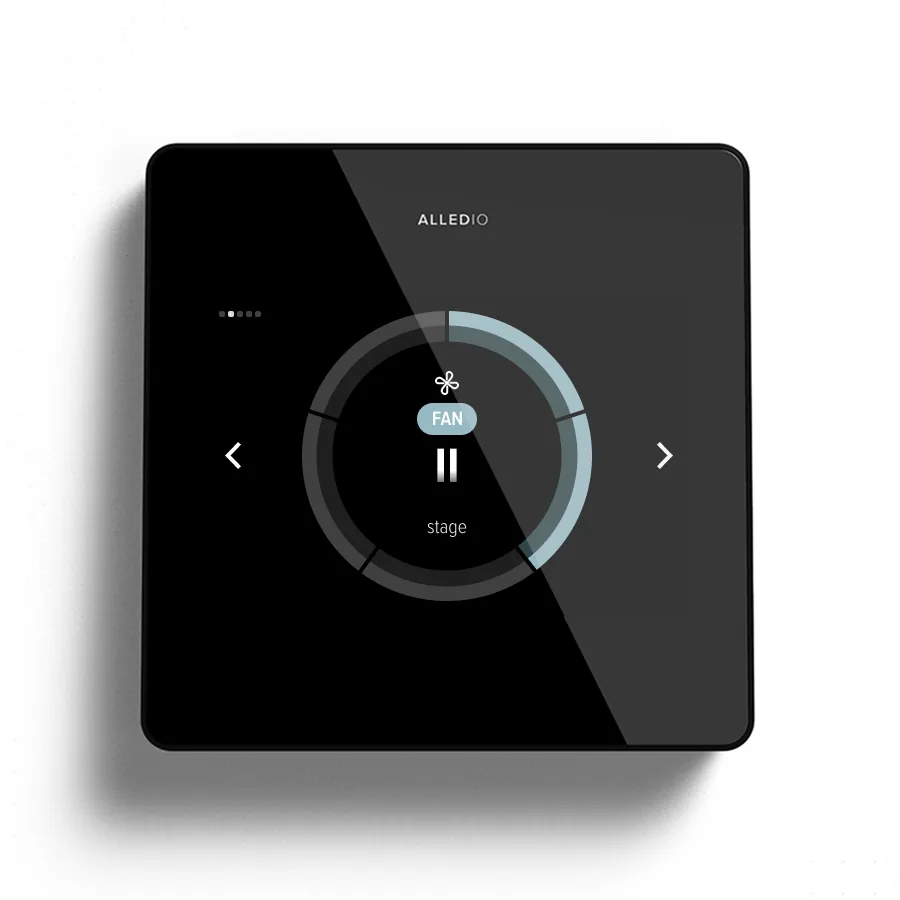

Do not force BACnet MS/TP onto this standard firmware path. Native BACnet is not published on the Room Controller catalogue line the way it is on the Multi-Sensor. Modbus RTU on RS-485 is the default copper citizen; Wi-Fi OTA and partner MQTT/REST are the connected options; BLE 5 is ready for commissioning maps you own.
KNX is likewise not a hidden catalogue checkbox here. If the RFQ says KNX, budget a separate firmware or hardware quote. That honesty is what keeps an RFQ from collapsing into a protocol wishlist nobody can manufacture on schedule.
Power and mechanics (18–42 V DC / 24 VAC)
OEM customisation covers logo, UI colours, widgets, hardware options, and firmware. You pay for the delta against a modular platform, not for reinventing a certified radio and a mould. Power for the Room Controller is 18-42 V DC (24 V recommended) or 24 VAC +/-25% - do not assume 230 VAC; that is the thermostat family.
3.5" glass in the same family as the Room Unit
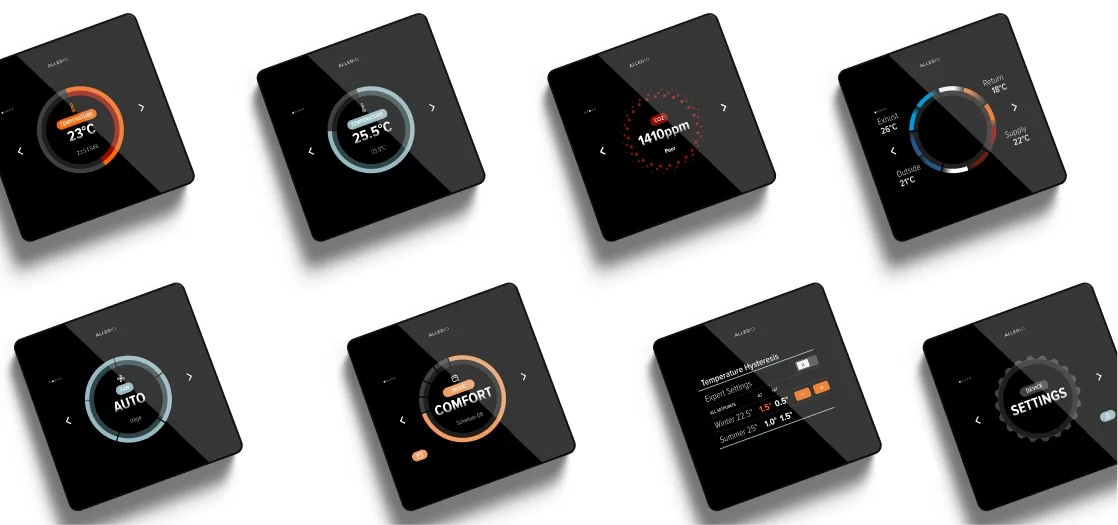
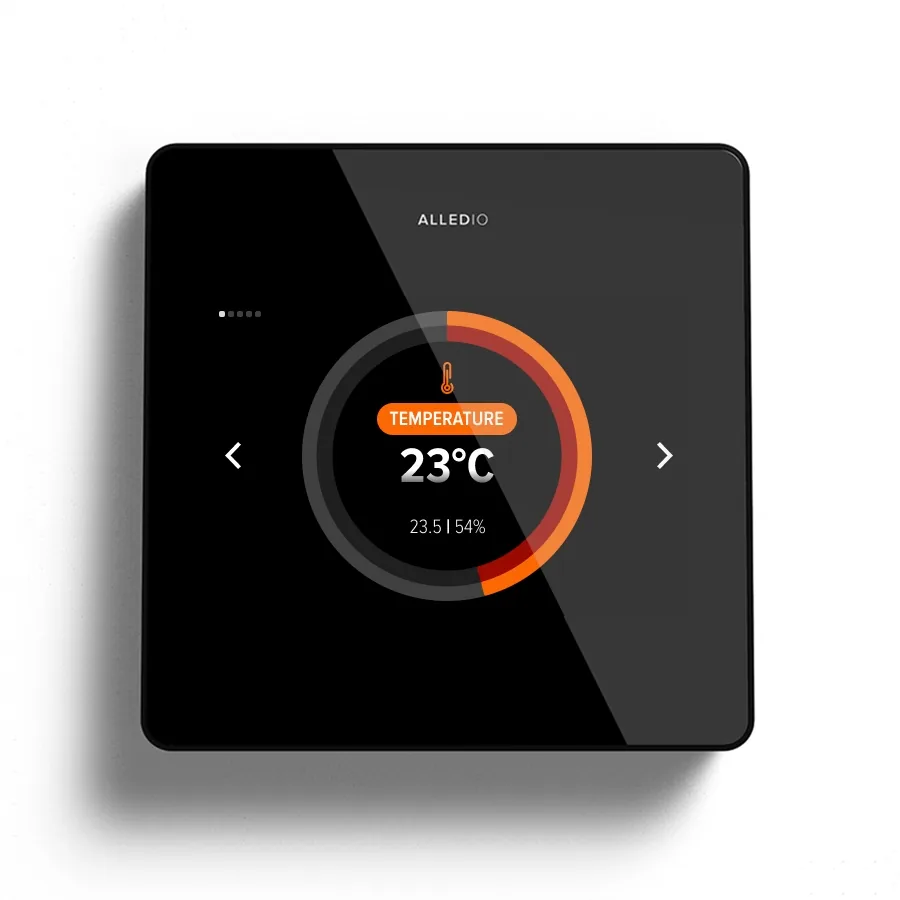
The glass is large enough for temperature, humidity, fan, and I/O status, and small enough to stay in a 98 x 98 x 23 mm IP20 housing. Capacitive glass and a flush mount keep the controller in the same visual family as the Room Unit - so hotels and offices do not see two different brands on adjacent walls. Specs for the panel itself live on the 3.5-inch OEM HVAC touch panel post; this page owns the controller I/O, not that glass keyword.
The same panel language showed up as a branded HVAC wall UI at Andivi at MCE Milano 2026. How the room feels - not only how the glass looks - is also the thread of Beyond design: it's how it feels.
When the RFQ also asks for flush depth, treat it as an OEM wall UI flush mount problem in the same family: same square, same glass language, different I/O and firmware load. That is how a controller line stays coherent next to a Room Unit SKU without two industrial designs fighting on the wall.


Product proof
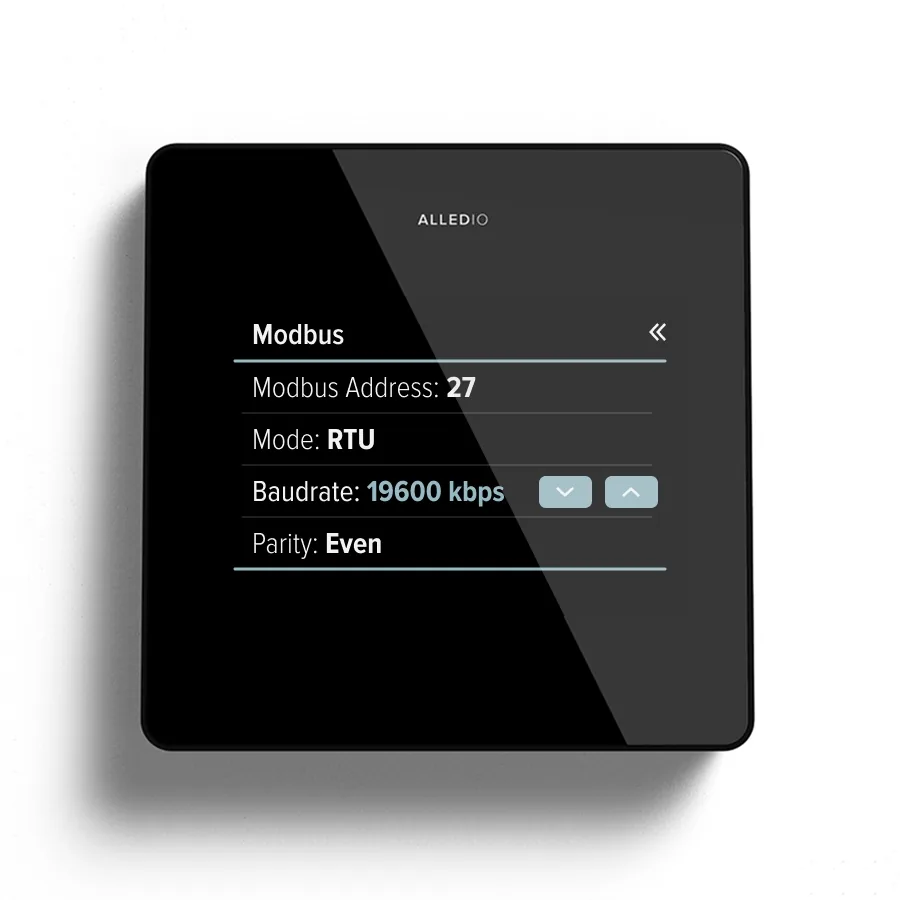
Published proof on the Room Controller is the combination of UX, universal I/O, and OEM apps: a 3.5" capacitive panel, T/RH standard with optional IAQ sensors, versioned I/O tables, Modbus on RS-485, Wi-Fi with OTA, partner MQTT/REST, and BLE 5 ready - designed in Slovenia for EU OEM programmes.
| Topic | Published spec |
|---|---|
| Display | 3.5" LCD, 480 x 320, capacitive touch, auto brightness |
| Sensors (standard) | Temperature and humidity |
| Sensors (optional) | VOC, CO2 (400-5000 ppm), pressure, presence |
| Universal I/O (max) | 2x UI, 3x UO, 1x UIO (TH / TH1 / TH2 / TH3) |
| I/O classes | Analogue 0-10 V / 4-20 mA; digital open-collector / 0-30 V input |
| Bus | RS-485 Modbus RTU (slave default; master on request), 9600-115200 |
| Radio / API | Wi-Fi 2.4 GHz with OTA; MQTT/REST for authorised partners; BLE 5 ready |
| Power | 18-42 V DC (24 V recommended) or 24 VAC +/-25%; ~0.3 W at 50% brightness |
| Mechanics | 98 x 98 x 23 mm, 150 g, IP20 |
| Origin | Slovenia, EU |
| Commercial | OEM-only; MOQ 1,000 (negotiable); samples with demo/test firmware |
Not a catalogue claim here: native BACnet on standard Room Controller firmware; a KNX SKU; installer webshop pricing; 230 VAC relays (Thermostat). Confirm any cell you cannot see on the current datasheet before you lock an RFQ. For firmware and hardware depth beyond the catalogue page, use hardware and software development.
Compliance for connected variants starts from RED 2014/53/EU, RoHS, and the 10-year security-update window in the OEM agreement. Ask for the document pack before the first production lot.
FAQ
How is the Room Controller different from the Room Unit?
The Room Unit is UI plus sensors for a host-driven wall face. The Room Controller adds universal I/O and application logic you specify in firmware.
How is it different from the Thermostat?
The Thermostat family is relay-centric for 230 VAC FCU-style loads. The Room Controller is universal I/O and low-voltage plant integration, not a Nest-style retail brick.
Can an installer buy one from a webshop?
No. Alledio sells to OEMs. Installers and SIs get devices through the OEM channel.
Can we get samples?
Yes. Samples of the Room Controller are available with demo or test firmware so your lab can validate I/O, Modbus, and the glass before production NRE. Samples are purchased; request them under NDA via the OEM conversation.
What is the MOQ?
MOQ starts at 1,000 units per the published Room Controller commercial model and is negotiable. Lead time is typically quoted after design and firmware are signed off.
Is BACnet in standard Room Controller firmware?
No. Native BACnet is not on the catalogue firmware. Custom BACnet is on request for named datapoints. KNX is not a catalogue SKU on this path.
What to do next
Start on the Alledio OEM Room Controller page, then open an OEM conversation for logo, UI, I/O version, firmware NRE, and samples. Bring the pin map, Modbus register draft, power class, sensor options, and MOQ. For deeper custom work, use hardware and software development. That is the shortest path from an RFQ sentence to a wall controller with universal I/O under your brand.