A 3.5 inch OEM HVAC touch panel is the wall face an HVAC brand can lock into a European box without redrawing the fascia. Industrial designers and mechanical teams need the envelope, the glass, the sensors, and the power first.
OEMHVACTemperatureHumidityCO2IAQ
Alledio’s Room Unit is that class of device: a capacitive OEM glass panel, 98 × 98 × 23 mm, designed and manufactured in Slovenia. The host still runs the plant. The wall unit is the industrial UI, the T/RH pack, and the RS-485 citizen.
Who this is for
This article is for industrial designers and mechanical OEM teams who own the wall cut-out, the back-box, and the faceplate language. Product managers and BMS buyers can use the same numbers. The first reader is the person who has to fit 98 mm of glass into an EU wall box.
Typical lines: AHUs, residential and commercial heat pumps, VAV and rooftop units, ductless mini-splits, VRV, chillers, boilers and DHW, plus actuator-facing UIs. End markets include offices, schools, hotels and museums. Installers and system integrators cannot buy Alledio direct. The commercial model is high-MOQ OEM (usual MOQ 1,000 pcs, negotiable). A sample is an NDA conversation, not a webshop.
If you need standalone I/O and application logic in the same family, that is the Room Controller, not this SKU. See how inputs and outputs are specified in the OEM room controller with universal I/O guide. Keep the Room Unit as the occupant glass. How Andivi works with OEM programmes is on About.
Mechanics: 98 × 98 × 23 mm on the wall
A flush mount is a mechanical contract, not a style note. The Room Unit is specified at 98 × 98 × 23 mm and 150 g, IP20, ABS plus scratch-resistant glass. That depth is meant to sit in a standard European wall box, not to hang as a surface brick.
Write the box class you already pull. Most EU indoor lines already accept a 98 mm fascia on a standard flush box. If your current thermostat uses a different plate language, say so in the RFQ. The drawing you get from /oem is for this envelope.
Flush also means the glass plane. Treat the 3.5" capacitive LCD (480 × 320) as the visible face and the 23 mm body as the thing that disappears into the wall. A brightness sensor keeps the glass readable in a lobby and quiet in a bedroom. Colourways (white, black, silver, plus custom) let the same electronics follow a hotel corridor, a school, or a heat-pump indoor unit.
Weight is part of the flush story. 150 g on a European box is a faceplate, not a hanging appliance. Ask for the mechanical drawing with the ICD so your CAD library has the same 98 mm square your fascia already uses. Do not draw a second cut-out for a hotel SKU and a heat-pump SKU if they share this board.
The Room Unit was on the floor at Smart Building Expo Milan 2025 as a branded HVAC wall UI. How the room feels, not only how the glass looks, is the thread of Beyond design: it’s how it feels.
Glass, sensors, and the 98 mm envelope
The display is a 3.5" LCD at 480 × 320 with capacitive touch and automatic illumination. That is enough for temperature, humidity, air quality, fan, schedule, and a one-tap absence, and small enough to stay inside the 98 mm square. Do not ask the factory to grow the glass. Grow the UI by widgets, not by millimetres.
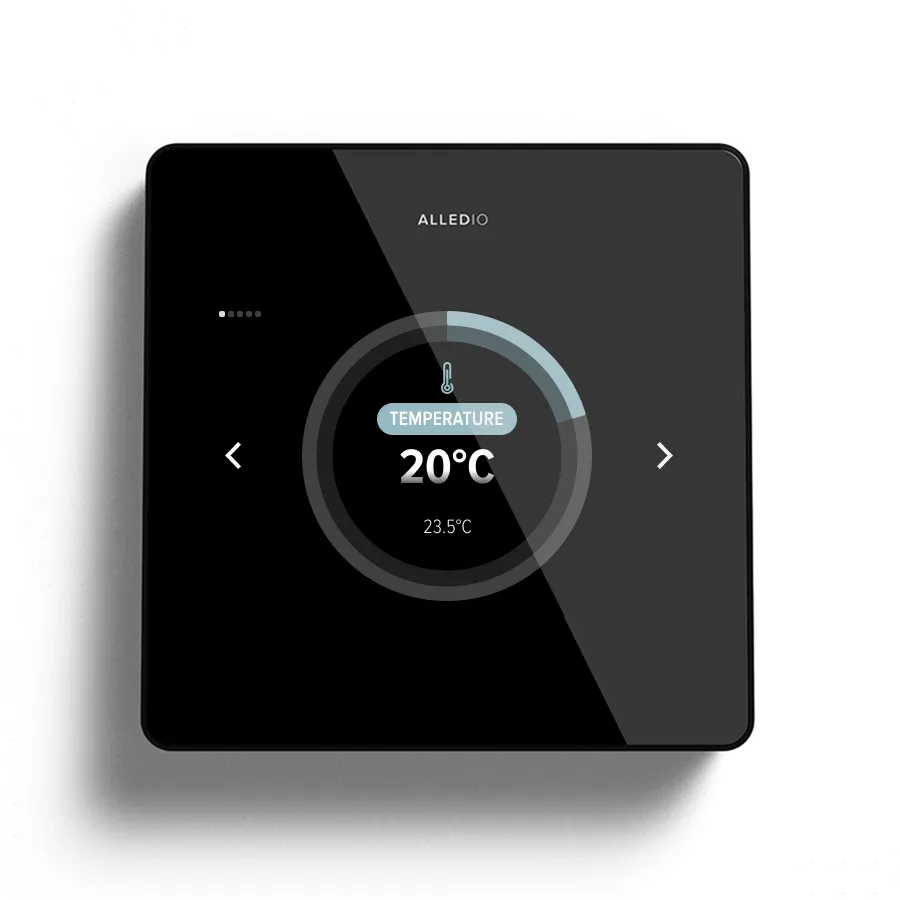
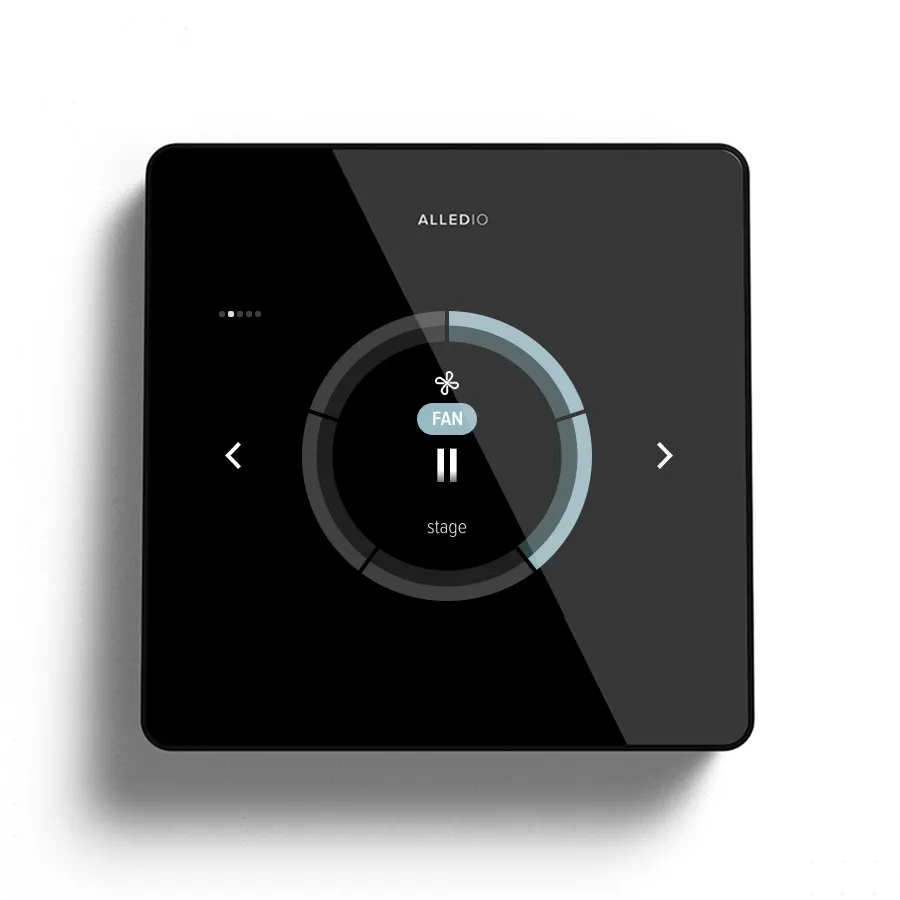
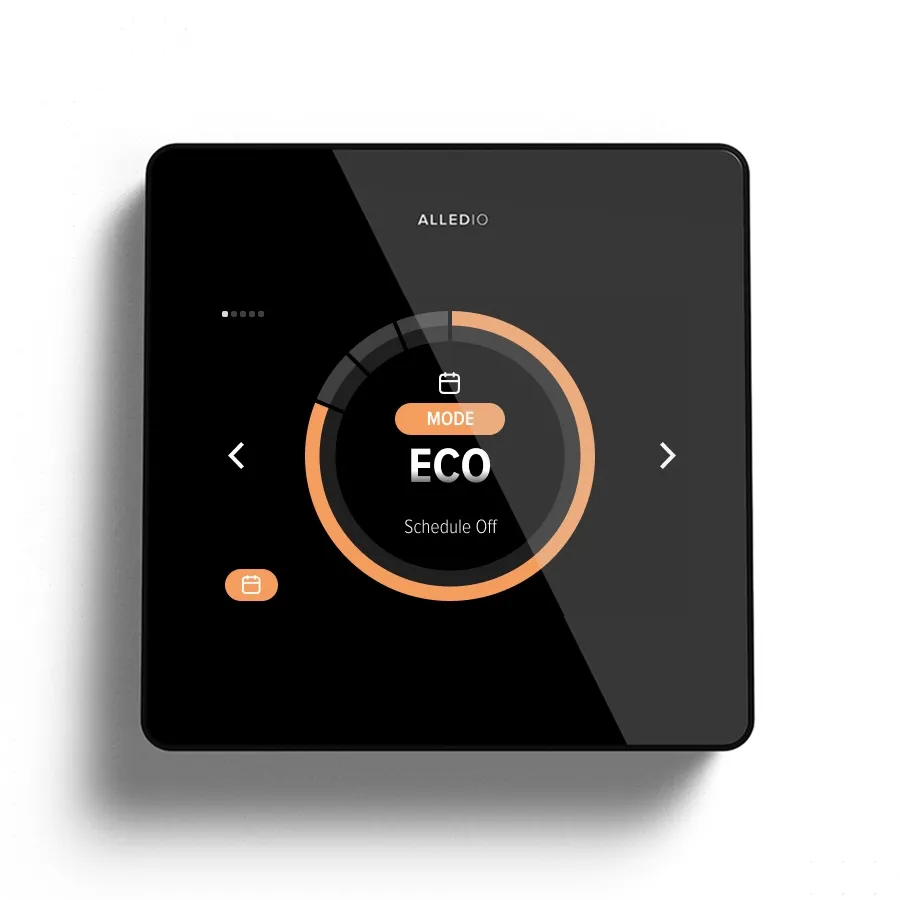
Sensors live in the same envelope. Temperature and humidity are standard digital sensors. Optional orderable variants: VOC, CO2 400–5000 ppm, pressure, presence. If your SKU needs IAQ on the wall, write it as an option, not as a second housing. Native BACnet sensing lives on the Multi-Sensor family. This unit is the occupant glass.
Published measuring ranges on the product page: temperature −40 °C to +125 °C, humidity 0–100 %, VOC index 1–500, CO2 400–5000 ppm, pressure 260–1260 hPa. Accuracy figures listed there include temperature average ±0.5 °C (0–60 °C) and humidity ±1.8 % (10–90 % at 25 °C). Put the option you need in the RFQ line. Do not assume every SKU ships with CO2.
Housing is flame-resistant ABS with scratch-resistant glass. Ingress is IP20. That is a dry indoor wall, not a wet-room or outdoor pack. If the indoor unit sits in a bathroom or a plant room, say so. This SKU is the room face. Device operating range on the product page is −40 °C to +85 °C and 0–80 % RH.
Connections are push-in CAGE CLAMP 0.2–0.75 mm². Communication cable is a twisted pair with drain wire and foil wrap, or equivalent, suitable for RS-485. Write the cable class you already pull and the maximum stub your BMS already allows. Late cable notes are how a flush box becomes a field modification.
Package dimensions on the product page are 130 × 130 × 40 mm at 180 g, including the protective case. Use those numbers for inbound logistics, not for the wall cut-out. The wall item stays 98 × 98 × 23 mm.
Power, copper, and the host
Power is 12–42 V DC (24 V recommended) or 24 VAC ±25%. Consumption is about 0.3 W at 50 % brightness. Maximum current on the product page is 1 A at 24 V DC/AC. Do not assume 230 VAC. That is the thermostat family (relays for a 3-speed fan and heat/cool). The Room Unit is a low-voltage industrial UI.
The default copper pair is Modbus RTU on RS-485, slave, 9600–115200 baud, parity none/even/odd, software-defined termination. Master only if you need it. Wi-Fi is 2.4 GHz STA/AP, used for OTA and HTTPS; MQTT and REST are for authorised partners. Bluetooth 5 LE is ready; the GATT map is yours. A 0–10 V analogue output is listed as a connectivity option.
None of that puts the plant in the wall. The Room Unit is host-driven. Setpoints, fan, schedule and alarms sit on the glass. Sequences, safeties and plant algorithms stay on the OEM controller you already certify. Recuperation views or a sanitary hot-water shortcut are firmware options, but they are still requests to a host unless you specified the Room Controller.
Write the host contract in one page: which registers are read-only sensors, which are writable setpoints, and which bits are alarms. If the wall unit can enter an unoccupied or boost state, say whether that is a local timer or a request the host must honour. Ambiguity here is how field teams later write plant logic into a display.
Compliance you can defend: RED 2014/53/EU, RoHS, and a 10-year security-update window. Country of origin is Slovenia, EU.
Product proof
| Topic | Published spec |
|---|---|
| Display | 3.5" LCD, 480 × 320, capacitive touch, auto brightness |
| Sensors (standard) | Digital temperature and humidity |
| Sensors (optional) | VOC, CO2 (400–5000 ppm), pressure, presence |
| Bus | RS-485 Modbus RTU, 9600–115200 baud |
| Power | 12–42 V DC or 24 VAC ±25%; ~0.3 W at 50% brightness |
| Mechanics | 98 × 98 × 23 mm, 150 g, IP20 |
| Origin | Slovenia, EU |
| Security support | 10-year update window |
Those numbers are what you can put on a mechanical drawing today. Confirm any cell you cannot see on the current datasheet before you lock a tool-shop date. Comfort copy on the site is specific: the unit manages how the room feels while the host and the plant do the energy work.
Brand pack versus the mechanical platform
White label is a separate conversation from the millimetres. Logo on glass, UI colours, widgets, firmware features, housing colourways, optional sensors, and packing language can follow your product family. The 98 mm square, the 3.5" glass, the RS-485 citizen, and the host-driven model stay the platform.
That split is written up as White Label HVAC Room Display for OEMs. Use that post for brand surfaces. Use this post for the envelope. OEM customisation is the NRE path: you pay for the delta, not for a new radio and a new mould.
Not a catalogue SKU on this product: native BACnet (that lives on the Multi-Sensor family); KNX; 230 VAC relays. If the RFQ says KNX, treat that as a separate firmware or hardware quote, not as a hidden checkbox on this page. A hotel SKU and a heat-pump SKU can still share one electronics revision.
FAQ
Is this a tablet on the wall?
No. It is an industrial UI: a host-driven Room Unit with T/RH, RS-485, and a 98 mm flush envelope. It is not a consumer slate.
Which sensors ship as standard?
Temperature and humidity are standard. VOC, CO2 (400–5000 ppm), pressure and presence are optional. Write the option in the RFQ. Do not assume every SKU ships with CO2.
Where do mechanical drawings come from?
Ask under NDA via /oem. The product page has the published envelope. The drawing pack is the CAD item you drop into the fascia.
Does the plant run in the wall unit?
No. The Room Unit is host-driven. Sequences and safeties stay on your controller, unless you specified the Room Controller.
Can we get samples?
Yes. Samples are available with demo firmware or test firmware, under NDA. This is not a webshop SKU. Start the conversation on /oem.
What is the MOQ?
The usual MOQ is 1,000 pcs, and it is negotiable. If you order several different versions of Room Unit or Room Controller and the combined quantity is over 1,000 pcs, we can go down to 500 on a version.
Can an installer buy this from a webshop?
No. Alledio sells to OEMs. Installers and SIs get units through your channel.
What to do next
Start on the Alledio Room Unit page for the live spec, then open an OEM conversation for drawings, samples, logo and UI. Bring box class, power, sensor options and MOQ. That is the shortest path from a 3.5 inch OEM HVAC touch panel sentence to a flush wall UI your indoor line can actually mount.