Fan coil platforms still ship with two motor families, and the controller decision follows the motor. This EC fan vs 3-speed AC fan coil comparison is written for HVAC OEM product and R&D engineers who have to choose a fan path, wire it, and keep the wall device honest about what it drives. We compare how each motor is controlled, what changes in efficiency, noise, and cost, and which Alledio device fits each path: the 230 VAC relay Thermostat for three-speed AC motors, or the Room Controller for 0-10 V EC drives.
Fan CoilEC Fan3-SpeedOEMHVACModbus

The short answer: EC fan vs 3-speed AC fan coil comparison
A 3-speed AC fan coil switches mains to one of three motor winding taps through relays. An EC fan coil runs a brushless motor with built-in electronics that follows a low-voltage speed signal, usually 0-10 V, and can modulate anywhere between minimum and maximum airflow.
For the product team, that means the controller output changes completely. Three interlocked relays serve the AC motor; one analogue output, often with an enable contact, serves the EC motor. Pick the motor first, then pick the controller output stage that matches it.
Neither path is wrong. Three-speed AC remains common where unit cost and installer familiarity dominate, while EC wins where part-load efficiency, quiet low-speed operation, and finer comfort control justify the higher motor price.
How a 3-speed AC fan coil motor is controlled
The classic fan coil motor is an AC induction motor with tapped windings. Each tap gives a fixed speed, and the controller energises exactly one tap at a time. Two taps live at once can damage the motor, so relay interlocking is a design requirement, not a nice-to-have.
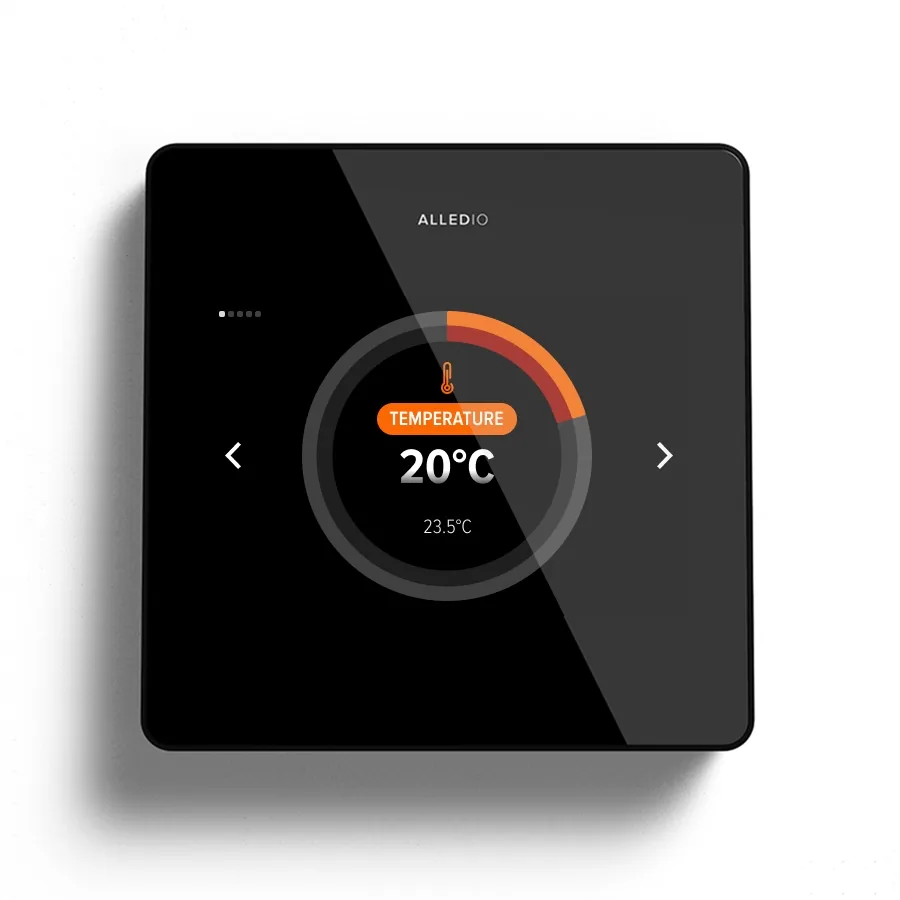
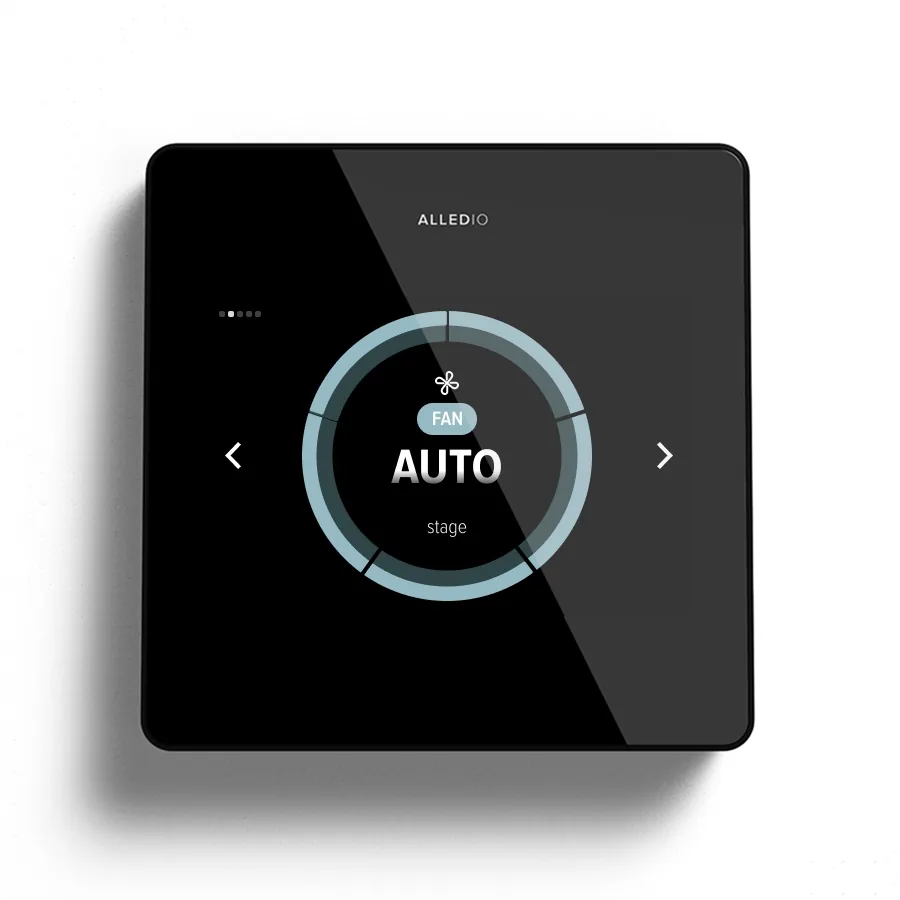
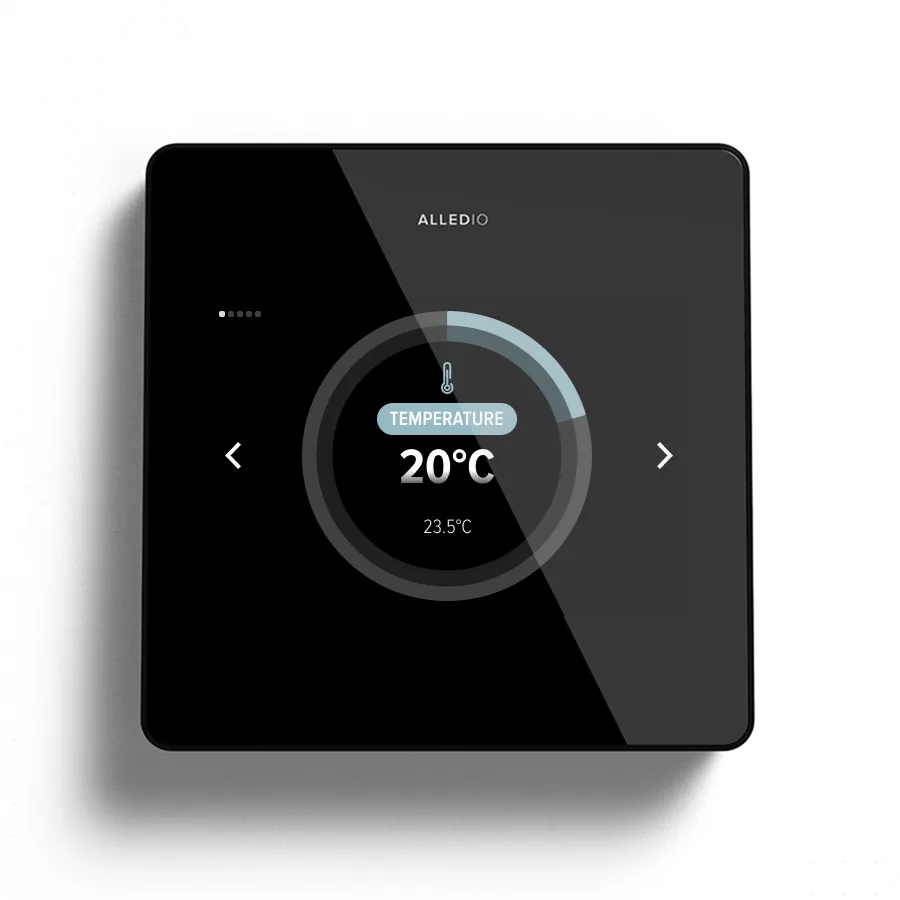
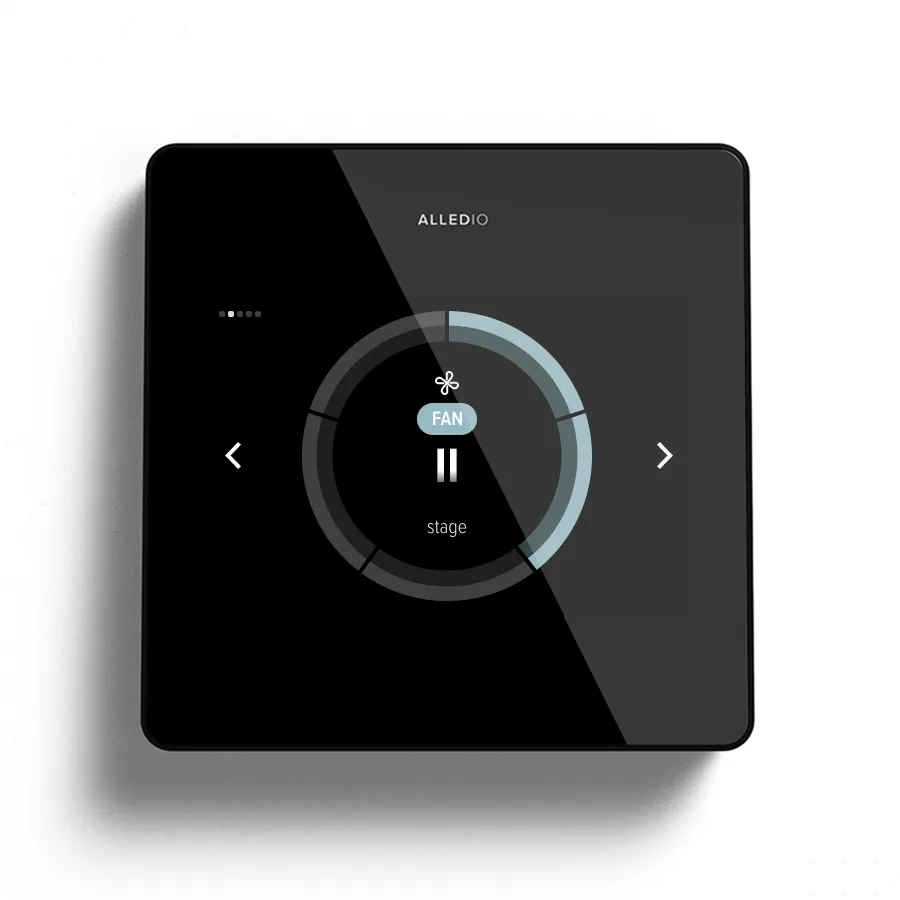
On the wall, users see off, speed 1, 2, 3, and auto. In auto, the controller picks a speed from the gap between setpoint and room temperature. The steps are audible, and the lowest speed is a fixed operating point rather than a tunable minimum.
The Alledio Thermostat is built for this path. The published product is 230 VAC powered with relays for three fan speeds (1 / 2 / 3 / auto / off), RS-485 Modbus RTU, and four I/O models. Our fan coil thermostat for 3-speed AC fans over Modbus covers the bus side in detail.
How an EC fan coil motor is controlled
An EC motor is a brushless DC motor whose commutation electronics sit inside the motor housing. Mains feeds the drive directly; the room controller only sends a speed reference, typically 0-10 V, and sometimes a separate enable or run contact.
Because speed is continuous, the controller can ramp airflow smoothly, hold a quiet minimum overnight, and match fan output to load. That is where most of the energy saving comes from: at reduced speed an EC motor avoids much of the winding loss a tapped AC motor keeps paying.
Decide the failure behaviour early. Most EC drives have a start threshold below which the motor stops, so define what the fan does if the signal wire breaks or the controller restarts, and write that fail-safe state into the unit specification.
Some EC drives also accept PWM or a fieldbus. Check the motor datasheet before you fix the interface, and always confirm the input impedance of the 0-10 V terminal against the output current your controller can source.
Side-by-side comparison for OEM product teams
For an EC fan vs 3-speed AC fan coil comparison at range level, the table summarises the differences that drive bill of materials, wiring, and commissioning time. It describes the motor technologies, not a specific motor brand.
| Topic | 3-speed AC fan coil | EC fan coil |
|---|---|---|
| Motor type | Tapped AC induction motor (typically PSC), mains-fed | Brushless DC motor with integrated electronic commutation |
| Speed control | Three fixed speeds; one relay energises one winding tap | Continuous modulation from a low-voltage speed reference, usually 0-10 V |
| Controller output | Three interlocked 230 VAC relays | One analogue output, often plus an enable contact |
| Part-load efficiency | Falls at low speed; losses stay in the windings | High across the range; the main reason EC is specified |
| Comfort and noise | Audible steps between speeds | Smooth ramps; low speed can be held quietly |
| Motor cost | Lower | Higher; electronics sit in the motor |
| Commissioning | Wire three taps and check the interlock | Scale min/max voltage and check the drive input |
| Alledio fit | Alledio Thermostat (3-speed relays, 230 VAC) | Alledio Room Controller (0-10 V on universal outputs) |
Cost sits in different places. A 3-speed AC unit puts relays and mains wiring on the wall device; an EC unit moves cost into the motor and keeps the wall device on low-voltage signals. That also changes who carries the electrical safety argument in your product file.
Noise is the other range-level argument. In hotel rooms, offices, and bedrooms, the lowest fan step is what occupants hear for most of the night. A 3-speed AC unit can only lower that step by re-tapping or changing the motor, while an EC unit lets the OEM set a quiet minimum airflow in firmware and adjust it per project without new hardware.
Which Alledio controller fits each fan path
3-speed AC fan: Alledio Thermostat
Specify the Alledio OEM Thermostat when the fan coil keeps a tapped AC motor. It switches the three fan speeds on its own relays, adds heating and cooling relays on the H/C model, and talks Modbus RTU to the BMS. When the speed relays must sit in the unit instead of behind the wall, see the fan coil thermostat with Modbus relay extender for 3-speed fan.
The Thermostat page lists optional analogue output (AO) models, but it does not publish EC fan control as a function. If an EC sequence must live on the Thermostat, raise it in the RFQ as OEM firmware scope instead of assuming it is a catalogue feature.

EC fan: Alledio Room Controller
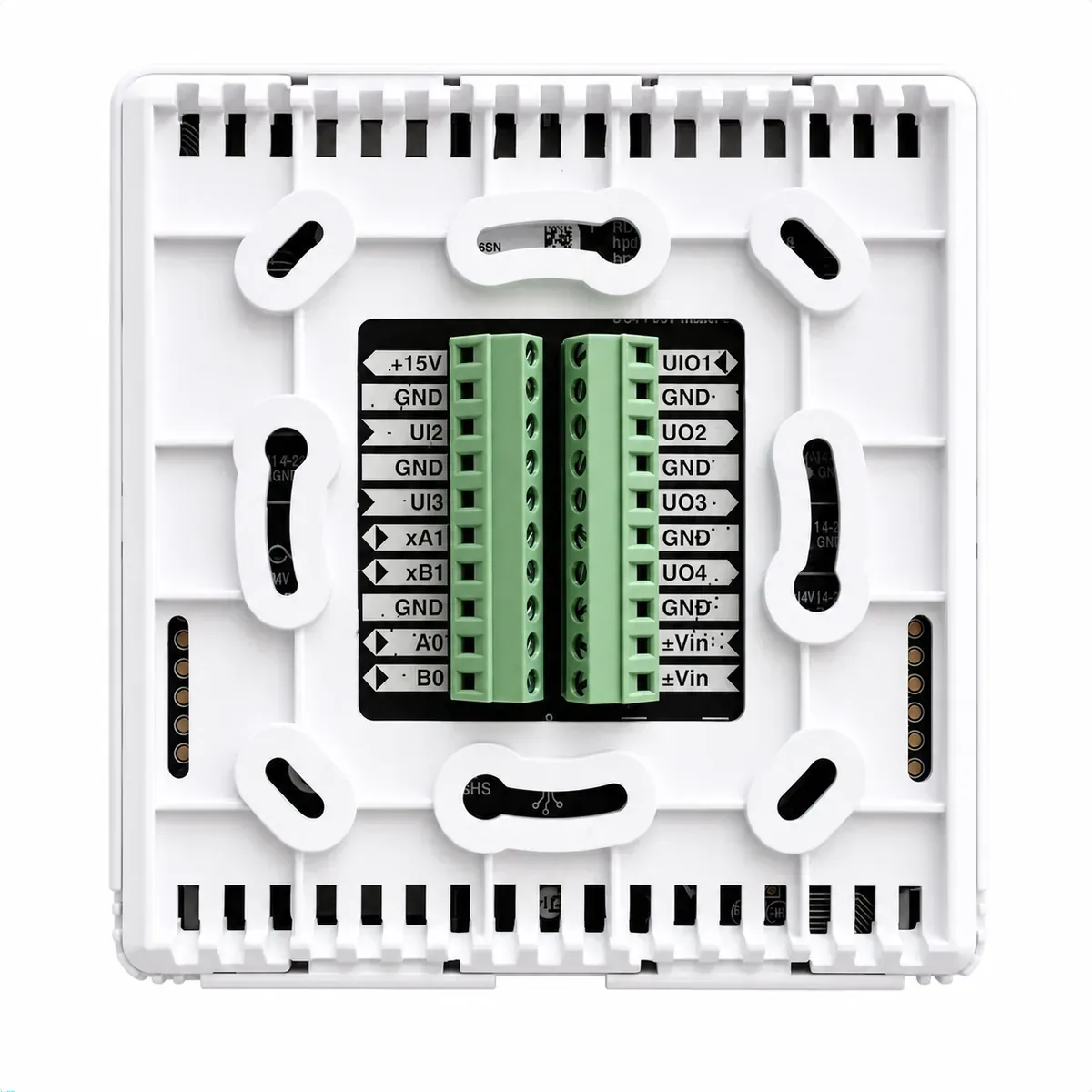
For an EC motor, the published fit is the Alledio OEM Room Controller. It runs on 18-42 V DC or 24 VAC and offers up to 2 universal inputs, 3 universal outputs, and 1 universal I/O. A universal output configured as 0-10 V analogue carries the fan speed reference, limited to 10 mA, while another output can provide the enable.
The same controller can drive heating and cooling valves as on/off or 0-10 V, which is why EC fan coil programmes usually land there. The 4-pipe fan coil room controller 0-10V article walks through a full I/O map, and the OEM Room Controller with universal I/O explains the output classes.
Mixed ranges with both motor options
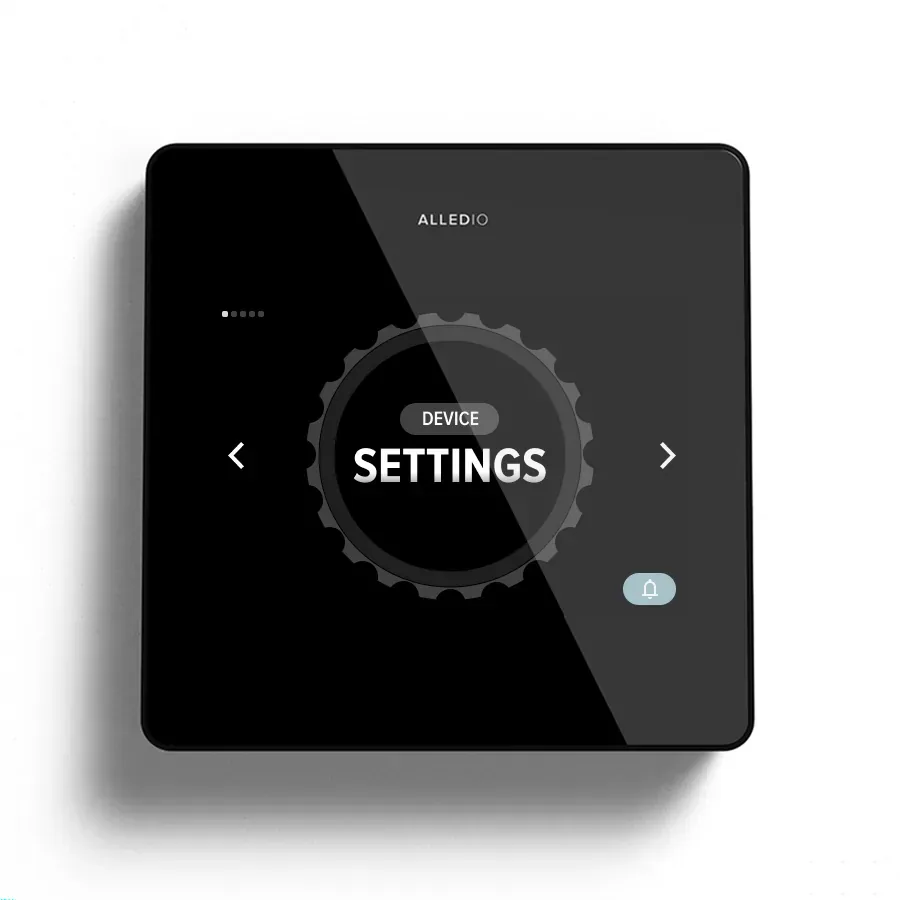
Many OEMs sell both motor options in one fan coil range. Keep one glass and UI family across both, and let the output stage decide the SKU: Thermostat for the AC variant, Room Controller for the EC variant. The white label room controller for HVAC shows how branding carries across. If the open question is which wall SKU each variant should use, see Room Unit vs Thermostat for OEM ranges.

Worked example: one fan coil range, two fan options
Take a 2-pipe cassette range offered with a 3-speed AC motor as standard and an EC motor as an upgrade. The comfort sequence is the same; only the fan output changes between variants.
- AC variant: Thermostat relays drive speed 1, 2, or 3; auto mode steps speed on temperature error; the H/C relay model switches the valve.
- EC variant (Room Controller TH3): UO2 sends the 0–10 V speed reference, UO3 enables the drive, UO4 drives the valve; UI2 and UI3 take a window contact or condensate alarm, and UIO1 stays free for an extra sensor or output.
- Both variants: Modbus RTU on RS-485 to the BMS, which can share one register map (OEM firmware scope).
Expose fan command and status as Modbus registers on both variants. The BMS then reads the same fan points whether the unit ships with an AC or an EC motor, and integrators reuse one template for the whole range.
Write minimum and maximum EC voltage into the commissioning sheet, because the motor manufacturer's 0-10 V curve rarely starts at zero airflow. For the AC variant, document which relay maps to which tap so service teams never cross-wire speeds.
Plan factory testing the same way. The AC variant needs a relay test per tap and an interlock check; the EC variant needs a 0-10 V sweep that confirms the drive starts, ramps, and stops at the documented thresholds. Scripting both tests against the shared Modbus fan points keeps end-of-line testing fast for each SKU.
If the three-speed variant is your volume product, the 3-speed FCU OEM thermostat buyer guide covers selection criteria and RFQ fields. Keep both variant sheets in one RFQ pack so purchasing sees the full range.

FAQ
Is EC always better than 3-speed AC?
No. EC is more efficient at part load and quieter at low speed, but the motor costs more. Three-speed AC stays competitive where unit price and simple service matter most.
Can the Alledio Thermostat drive an EC fan?
The published Thermostat fan path is three-speed relays. Analogue output models exist, but EC fan control is not a published function, so treat it as OEM firmware scope in the RFQ.
Which Alledio device should drive a 0-10 V EC fan?
The Room Controller. Its universal outputs can be configured as 0-10 V analogue, and further outputs handle enable and valves.
Does an EC fan need a different wall UI?
Not necessarily. The same fan widget can show levels or auto; showing a percentage for EC is a UI change handled in the OEM firmware scope.
Can a 3-speed AC range move to EC later?
Yes, at range level. Swap the motor and move that variant from the Thermostat to the Room Controller; if both variants already expose the same Modbus fan points, the BMS integration stays the same.
Can we get samples?
Yes. Samples are purchased and ship with demo or test firmware, so your team can test the fan sequence before committing.
What is the MOQ?
MOQ is 1,000 pcs and negotiable. Firmware modifications are quoted separately.
Can installers buy directly?
No. Alledio sells OEM-only to companies that build their own HVAC equipment.
What to do next
Decide the motor per variant, then open the Alledio OEM Thermostat page for 3-speed AC or the Room Controller page for EC. Start an OEM conversation to request samples with demo firmware and a quote for your range.