Choosing the wrong wall device is an expensive RFQ. A clear room unit vs thermostat OEM decision separates a host-driven Room Unit, where your controller or BMS runs the plant, from a 230 VAC Thermostat that switches fan speeds and heating or cooling with its own relays. This guide gives HVAC OEM product managers the power class, output class and protocol facts to pick one family per riser - and shows when the Room Controller is the better answer because universal I/O has to live in the wall.
OEMRoom UnitThermostatRoom ControllerHVACCompare
Who this comparison is for
This article is for HVAC OEM product managers, controls engineers and BMS product owners deciding which Alledio family belongs in the next platform RFQ - not for installers. End markets include offices, hotels, schools and museums; devices ship through your own channel under your brand.
The commercial model is the same across all three families. MOQ starts at 1,000 pcs per order and is negotiable for programmes that combine versions. Samples are purchased with demo or test firmware through the OEM programme, so your lab can validate glass, bus and outputs before you commit NRE. Designed in Slovenia, manufactured in the EU.
Use this comparison when stakeholders still say "thermostat" for every wall glass. Move the conversation onto power class, output class and who owns the plant, then pick the family that matches. That discipline is the real OEM decision.
Procurement often wants one part number for every country. Resist that. A 230 VAC Thermostat and a 24 V Room Unit are not interchangeable spares. Publish a family matrix in your catalogue so distributors cannot substitute across power classes.
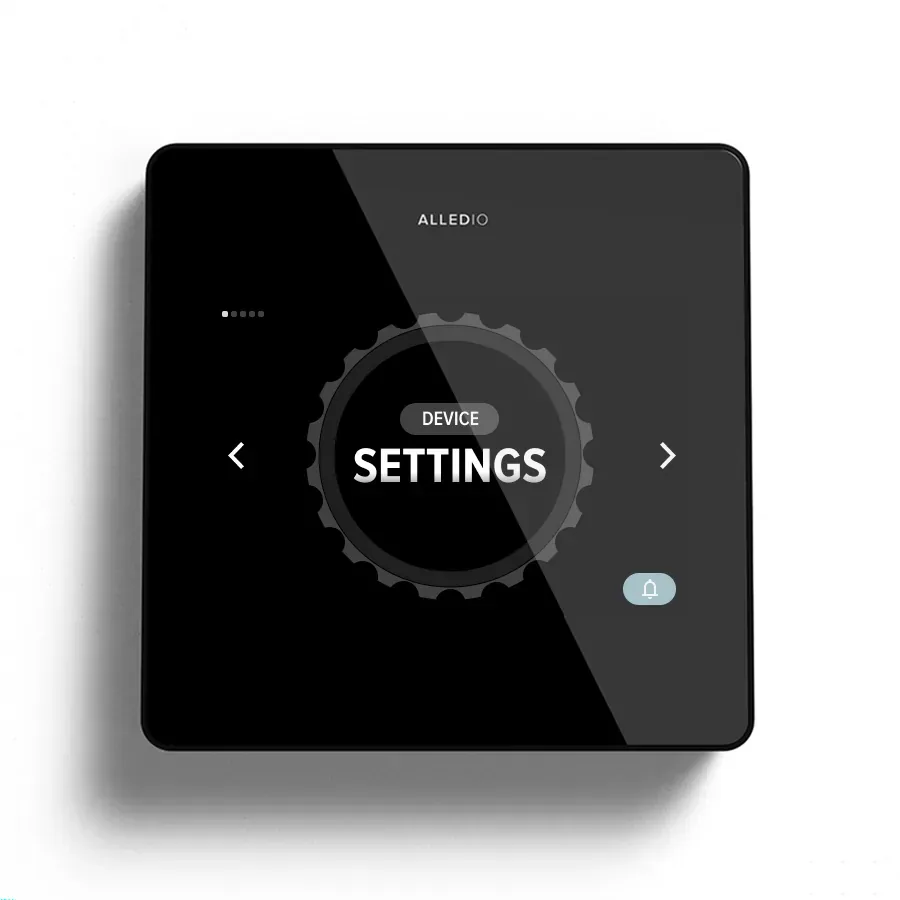
Room Unit vs Thermostat OEM: power, relays and who owns the plant
What the RFQ is really asking
Most RFQs that say "thermostat" are really asking three questions: what voltage reaches the wall box, what the wall device must switch, and where the control algorithm lives. Answer those three in writing and the family choice usually makes itself.
Host, wall node and I/O split
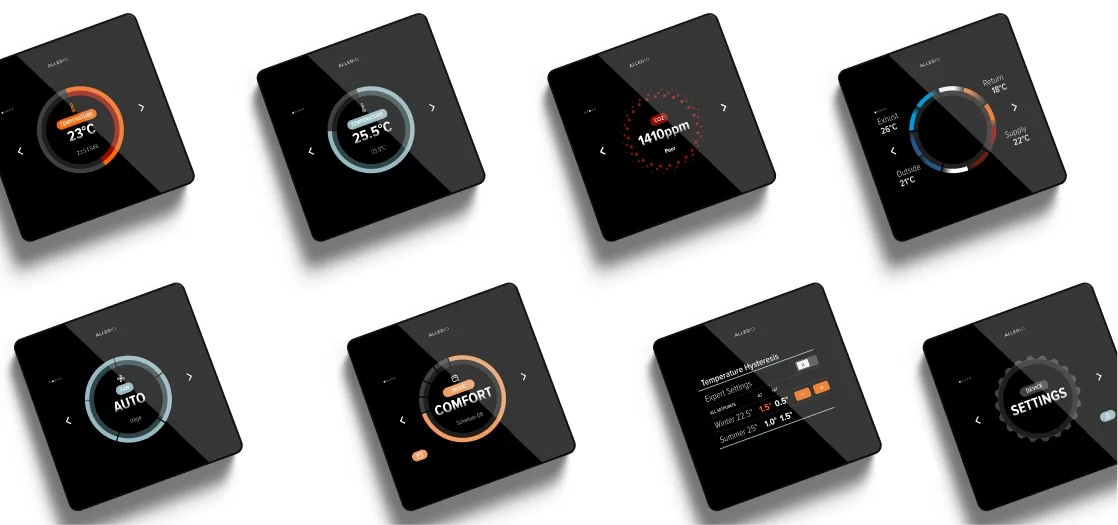
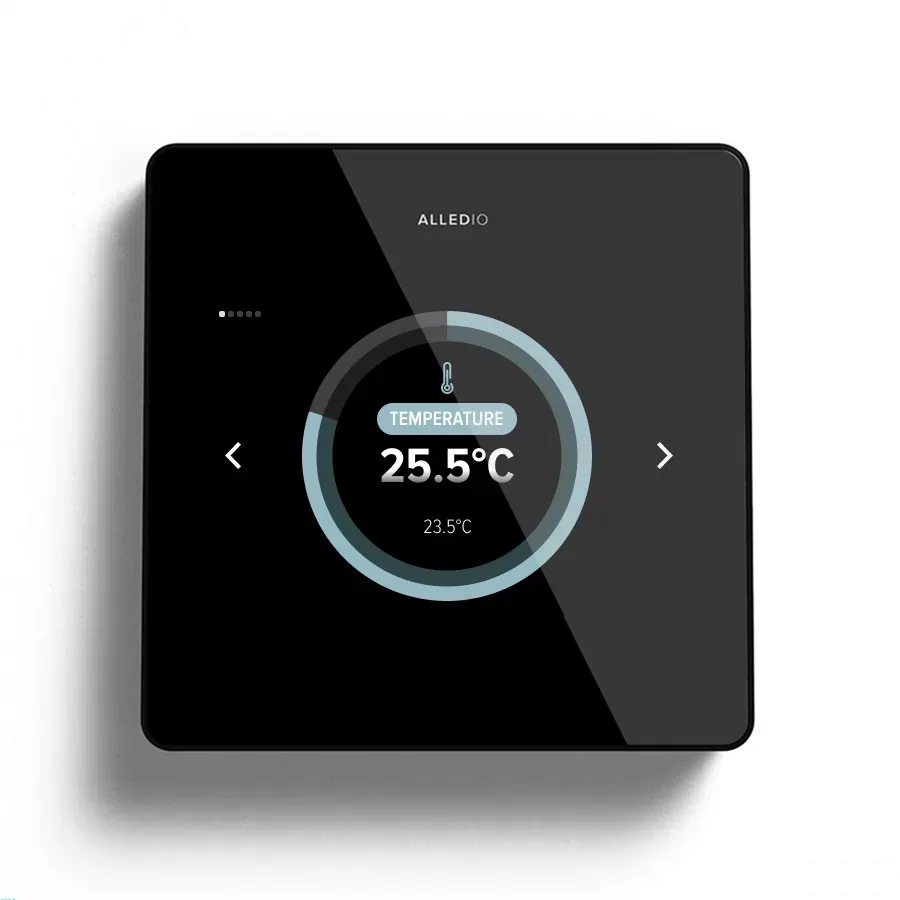
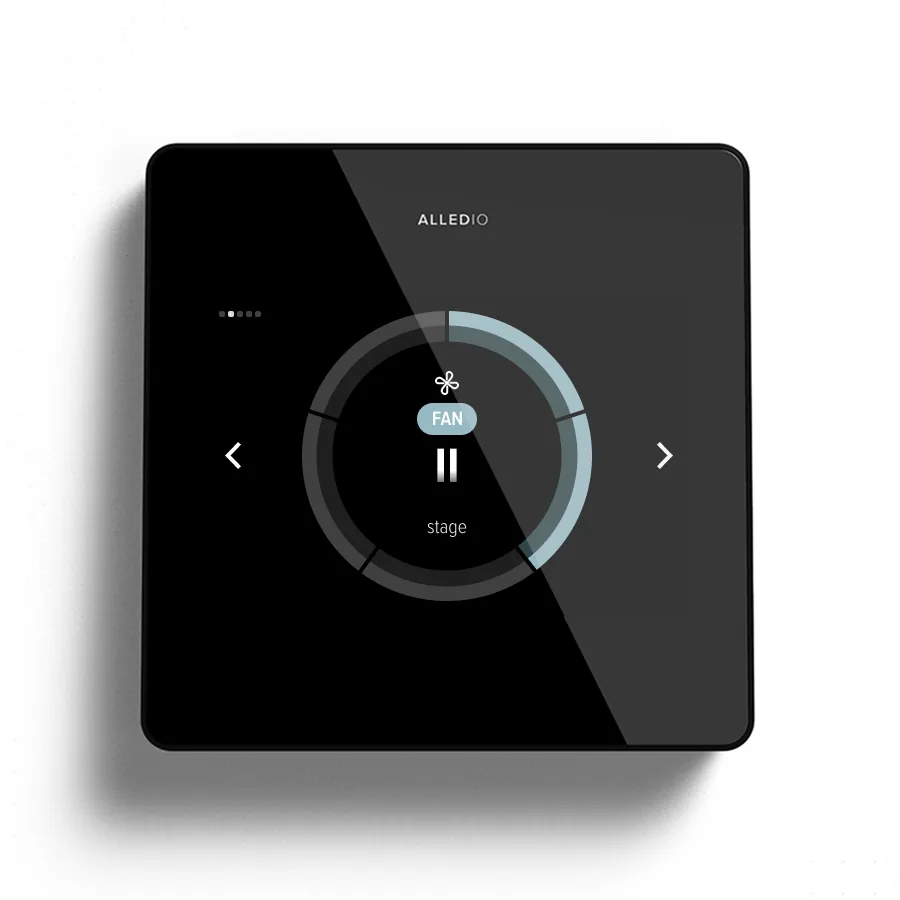
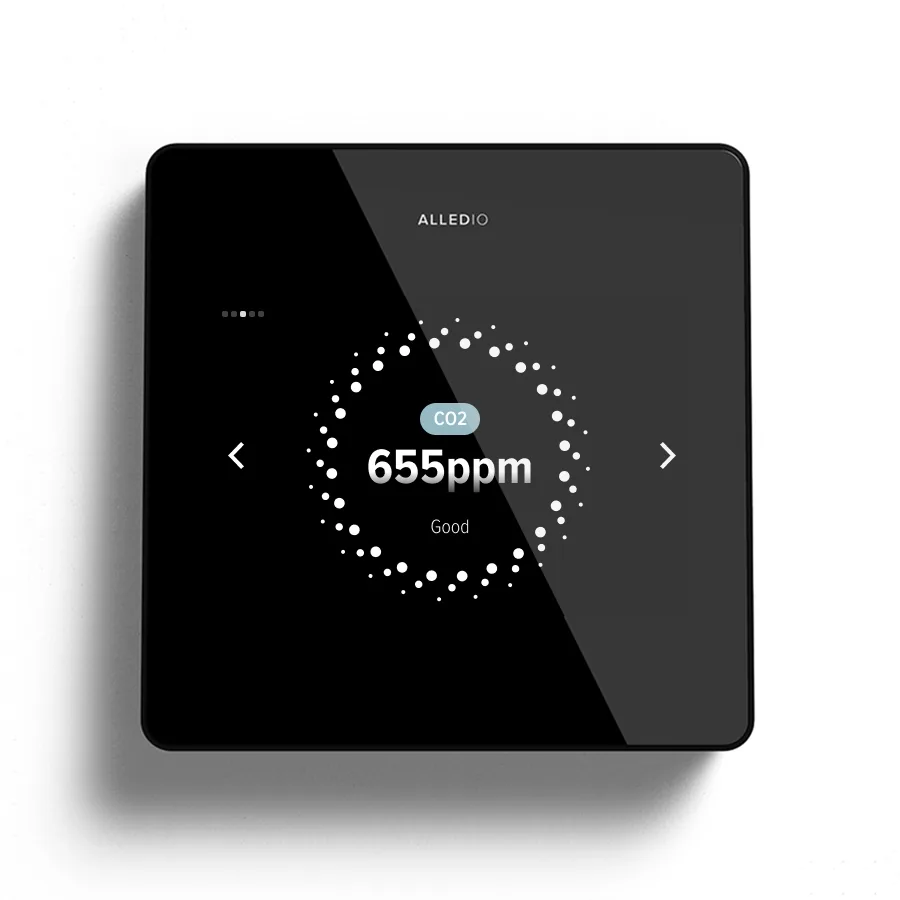
The Room Unit is a host-driven 3.5" capacitive UI with sensors: 12-42 V DC or 24 VAC, temperature and humidity as standard, optional VOC, CO2 (400-5000 ppm), pressure and presence. It has no relays; one optional 0-10 V analogue output covers a simple modulating signal. Plant algorithms stay on the board or BMS you certify.
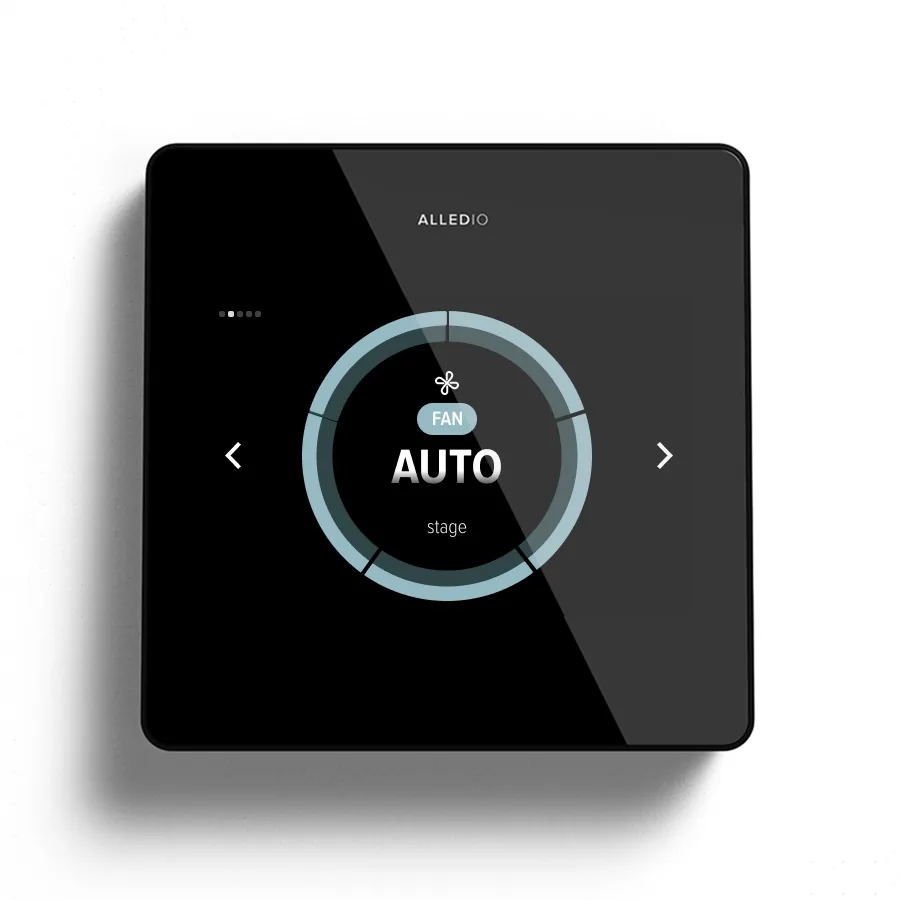
The Thermostat is the mains-relay device: 230 VAC supply, three fan-speed relays (1/2/3/auto/off) and, depending on model, two 0-10 V outputs, two digital outputs, one of each, or two heating/cooling relays, plus an NTC input. Use it when the FCU still expects contact closures at the wall. Pair it with 3-speed FCU OEM thermostat and OEM Modbus relay thermostat for three-speed projects.
Mixing these power stories in one PO is how commissioning invents a field adapter. Write the supply class and the output class in the first RFQ sentence.
Hotels that already pull mains to every room box often keep the Thermostat. BMS and cloud programmes that want a thin, branded UI usually keep the Room Unit. Neither choice is "more premium" - each matches a wiring reality.
Education campuses and museums often split: Thermostat on older FCU risers, Room Unit on new BMS floors. That split is healthy if documentation names the part number per riser and training does not blur the faces.
Room unit vs room controller: when I/O enters the wall
Pick the Room Controller when universal I/O and local control loops must sit in the same glass family: published maximum 2× UI, 3× UO, 1× UIO, 0-10 V or 4-20 mA on outputs, power 18-42 V DC or 24 VAC, mechanics 98 × 98 × 23 mm. Start from OEM room controller with universal I/O.
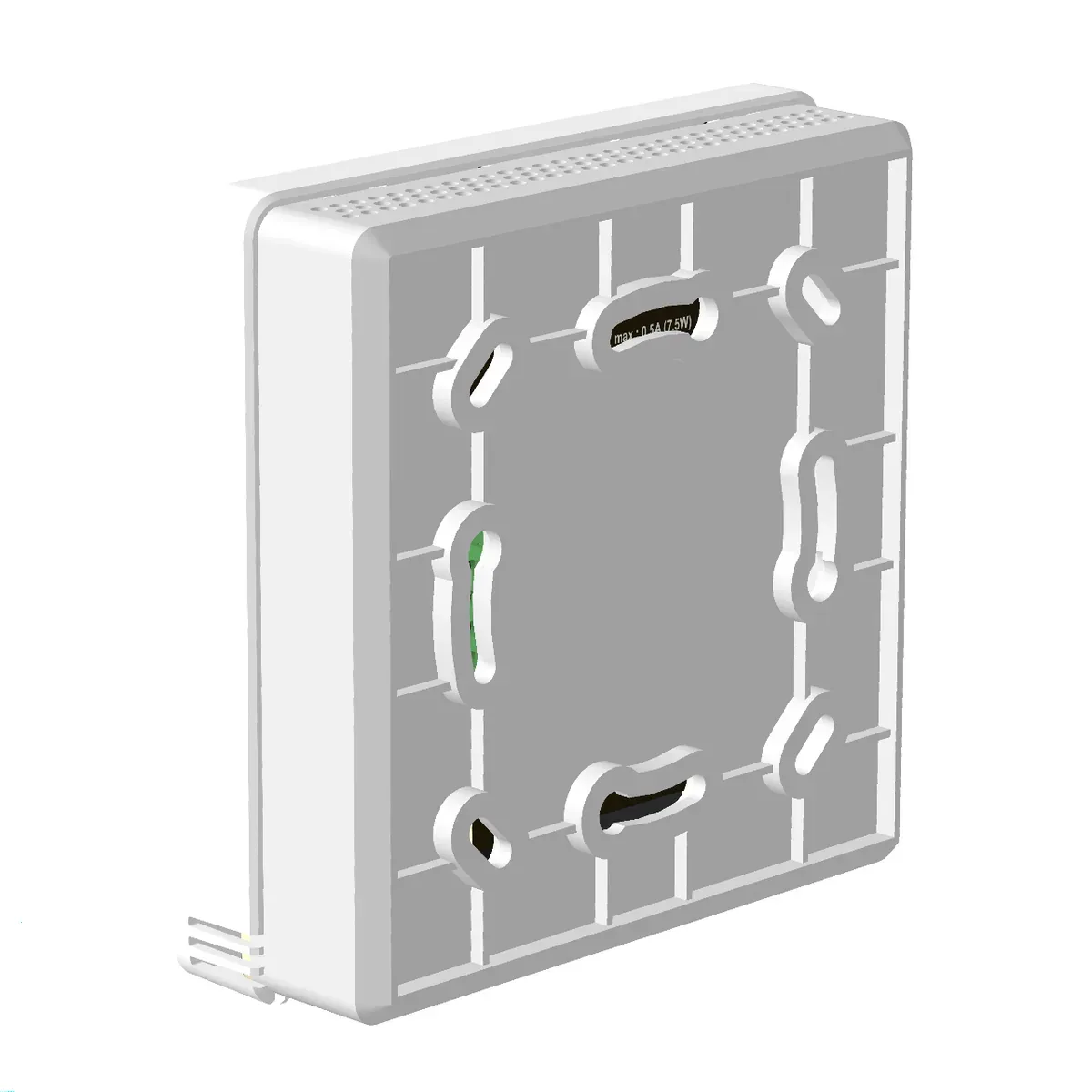
The Room Unit stays thinner on responsibility: sensors and UI, with the plant on the host. The Room Controller adds terminals and its own loops. The Thermostat adds mains relays. Three families, three RFQs. Do not ask one part number to pretend it is the other two.
For analogue FCU valves, choose the Room Controller - see the 2-pipe and 4-pipe guides. For three-speed AC fans on 230 VAC, stay on the Thermostat. For BMS-hosted comfort UI, stay on the Room Unit. Keeping the families separate keeps purchasing clear and RFQs short.
The Room Controller can also drive three-speed fans and on/off valves through the MR5 five-channel Modbus relay extender, which leaves its own universal I/O free for sensors. That is the route when a 24 V platform still meets an AC fan motor.
When a tender forces "one wall device" language, answer with three part numbers and a decision tree. Ambiguous tenders are how projects end up with a relay thermostat driving an EC fan through a field converter.

Decision table
| Topic | Room Unit | Thermostat | Room Controller |
|---|---|---|---|
| Power | 12-42 V DC (24 V recommended) or 24 VAC ±25% | 230 VAC | 18-42 V DC (24 V recommended) or 24 VAC ±25% |
| Outputs | One optional 0-10 V analogue output; no relays | Three fan-speed relays (1/2/3/auto/off) plus, per model, 2× 0-10 V, 2× digital, 1× 0-10 V + 1× digital, or 2× heat/cool relays | Universal I/O max 2× UI, 3× UO, 1× UIO (0-10 V or 4-20 mA); optional MR5 relay extender |
| Fan path | Host or BMS owns the fan command | 3-speed 230 VAC relays at the wall | 0-10 V / EC on UO, or 3-speed via MR5 relays |
| Who owns logic | Host or BMS you certify | Local relay control of fan and heat/cool | Own control loops in the wall; can also run as Modbus slave under a BMS |
| Mechanics | 98 × 98 × 23 mm | 98 × 98 × 14 mm | 98 × 98 × 23 mm |
| Typical RFQ | Branded UI + sensors for host-driven or cloud programmes | FCU that still expects contact closures at the wall | Valves, dampers and fans driven from the wall glass |
Read the table from the top. Power class rules out half the options before anyone discusses features, and output class settles the rest. If a row is still unclear after that, the sample stage is where you test it, not the first production lot.
Protocols Alledio actually ships
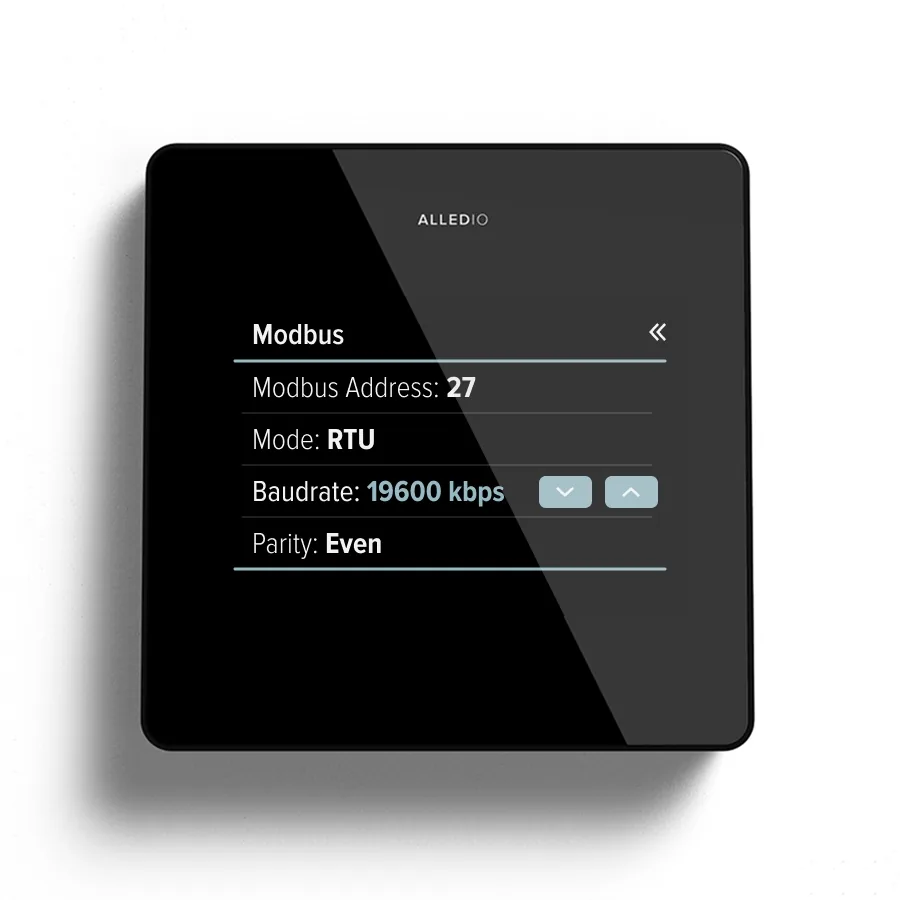
The bus default across all three families is Modbus RTU on RS-485: half-duplex, 9600 to 115200 baud, parity none, even or odd, slave by default with master firmware on request. If your product line already has a Modbus map your integrators know, matching register numbers and scaling is usually a small firmware change.
Room Unit and Room Controller add 2.4 GHz Wi-Fi with over-the-air updates and HTTPS; REST and MQTT access is restricted to authorised partners. The Room Unit is Bluetooth 5 (LE) ready. Thermostat Wi-Fi is currently used for updates only.
BACnet is not in the standard firmware of any of these three families; custom datapoints can be quoted on request. When stakeholders want native BACnet at the wall, answer with the Multi-Sensor and a separate quote. KNX is not a catalogue option. Keeping this protocol honesty protects delivery dates.
Compliance language for connected variants starts from RED 2014/53/EU and RoHS. Confirm the document pack for the exact model you quote.
White label, MOQ and NRE across the three families
OEM customisation covers logo, UI, colourway, sensor mix, packing and documentation on each family. Point a Room Unit RFQ at Room Unit material and a Thermostat RFQ at Thermostat material, for example white-label FCU thermostat. Keep brand programmes on the matching part number.
A tweak to screens or parameters is a tweak. A genuinely new firmware build is a project with planning, development and test cycles, and it is quoted as NRE rather than hidden in unit price. Bring your sequence description early so the estimate is honest.
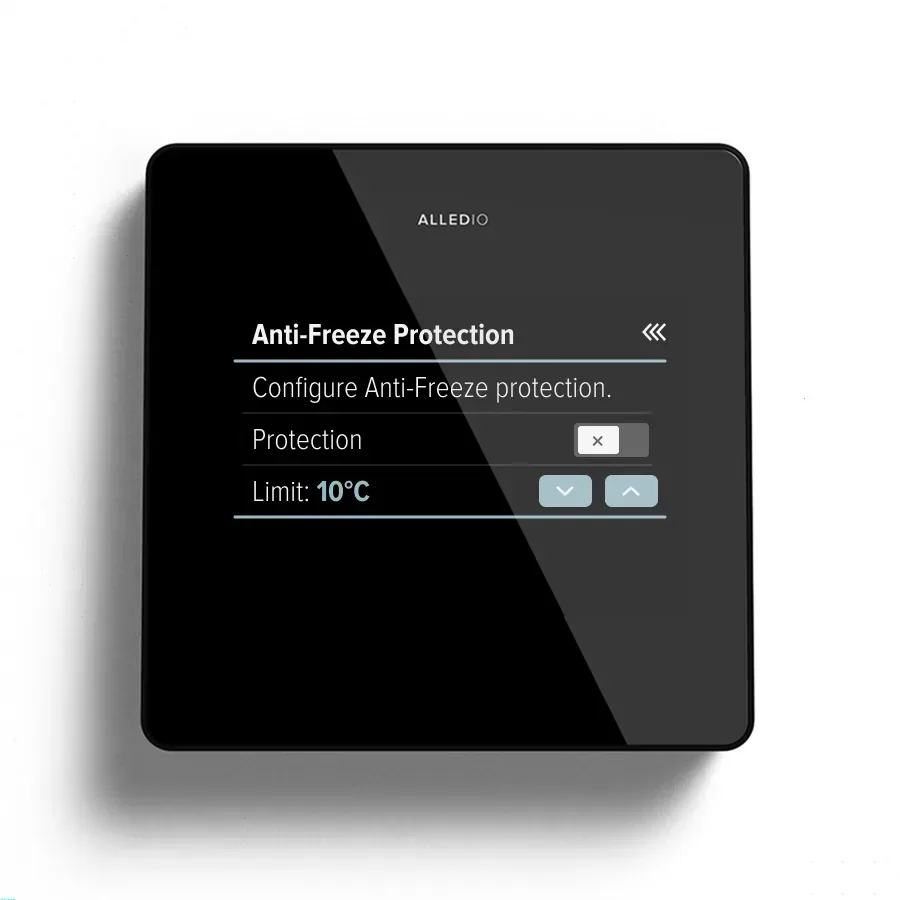
The same glass language across Room Unit and Room Controller helps hotels and offices avoid two industrial designs on adjacent walls, while the Thermostat stays the slim mains device. See also 3.5 inch OEM HVAC touch panel, the Room Unit at Smart Building Expo and how it feels.
FAQ
Can an installer buy either device from a webshop?
No. Alledio is OEM-only. Installers and system integrators buy through the OEM manufacturer that brands the device.
Does the Room Unit or the Thermostat run the full plant alone?
The Room Unit is host-driven - the plant stays on your controller or BMS. The Thermostat switches fan speeds and heating or cooling locally with its relays; certified plant strategy still belongs in your system design. The Room Controller runs its own control loops with universal I/O.
When do we pick the Room Controller instead?
When universal I/O, such as 0-10 V valves, dampers or an EC fan signal, must sit in the wall with the glass, or when three-speed fans should be switched through the MR5 relay extender on a 24 V platform.
Can we get samples?
Yes. Samples are purchased with demo or test firmware through the OEM programme, so your lab can validate glass, bus and outputs before production NRE.
What is the MOQ?
MOQ starts at 1,000 pcs per order for Room Unit, Room Controller and Thermostat, and it is negotiable for programmes that combine versions. Lead time for the Room Controller is 8-12 weeks once design and firmware spec are signed off.
Is BACnet or KNX a catalogue option on these families?
No. BACnet is not in the standard firmware and is quoted per datapoint on request; KNX is not offered. For native BACnet sensing, look at the Multi-Sensor.
What to do next
If the wall is UI and sensors only, open Room Unit. If the wall needs 230 VAC relays, open Thermostat. If the wall needs universal I/O, open Room Controller. Then start an OEM enquiry or contact the team for samples and NRE. Bring power class, output class and target volume so the wall decision survives purchasing.