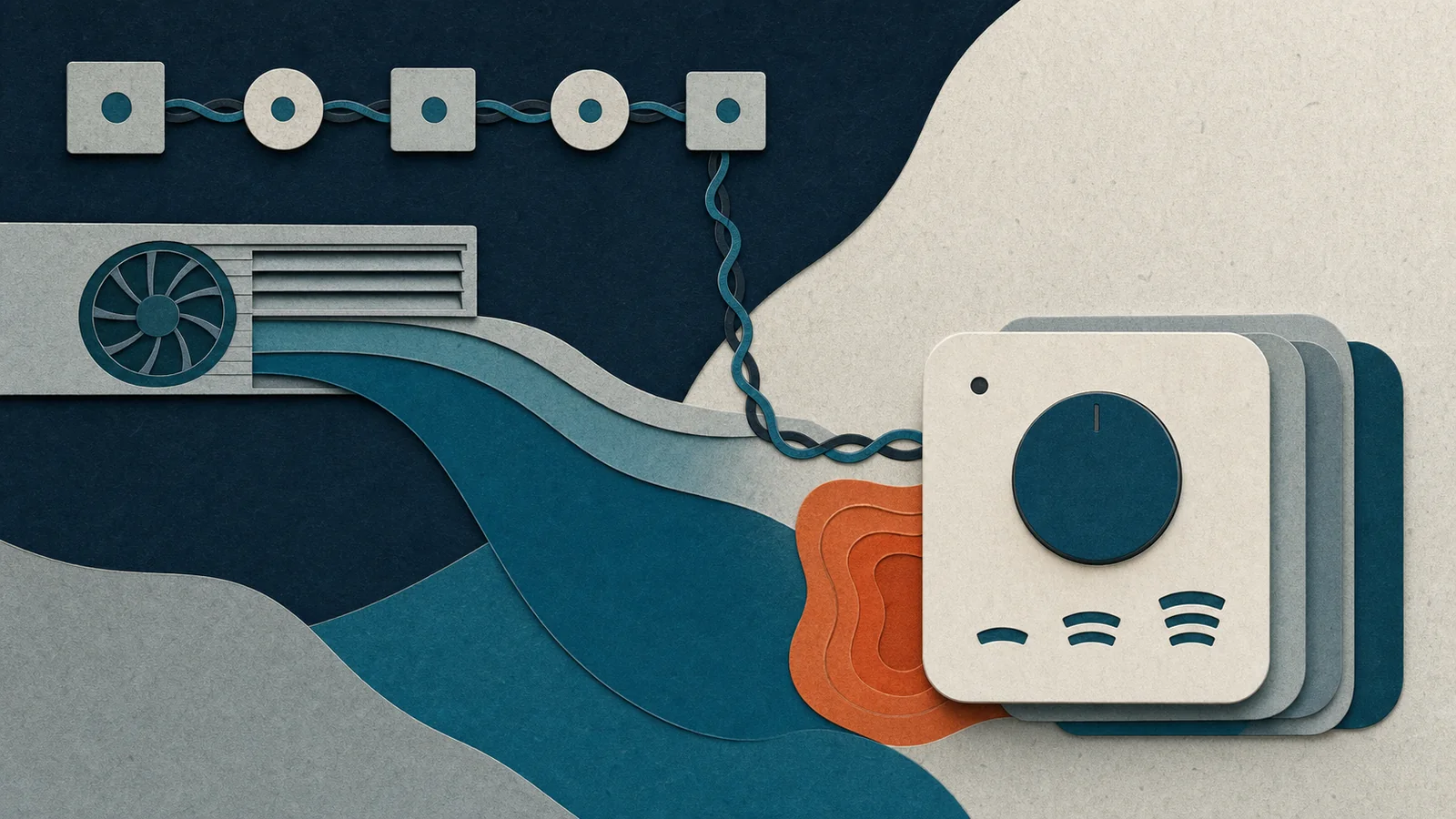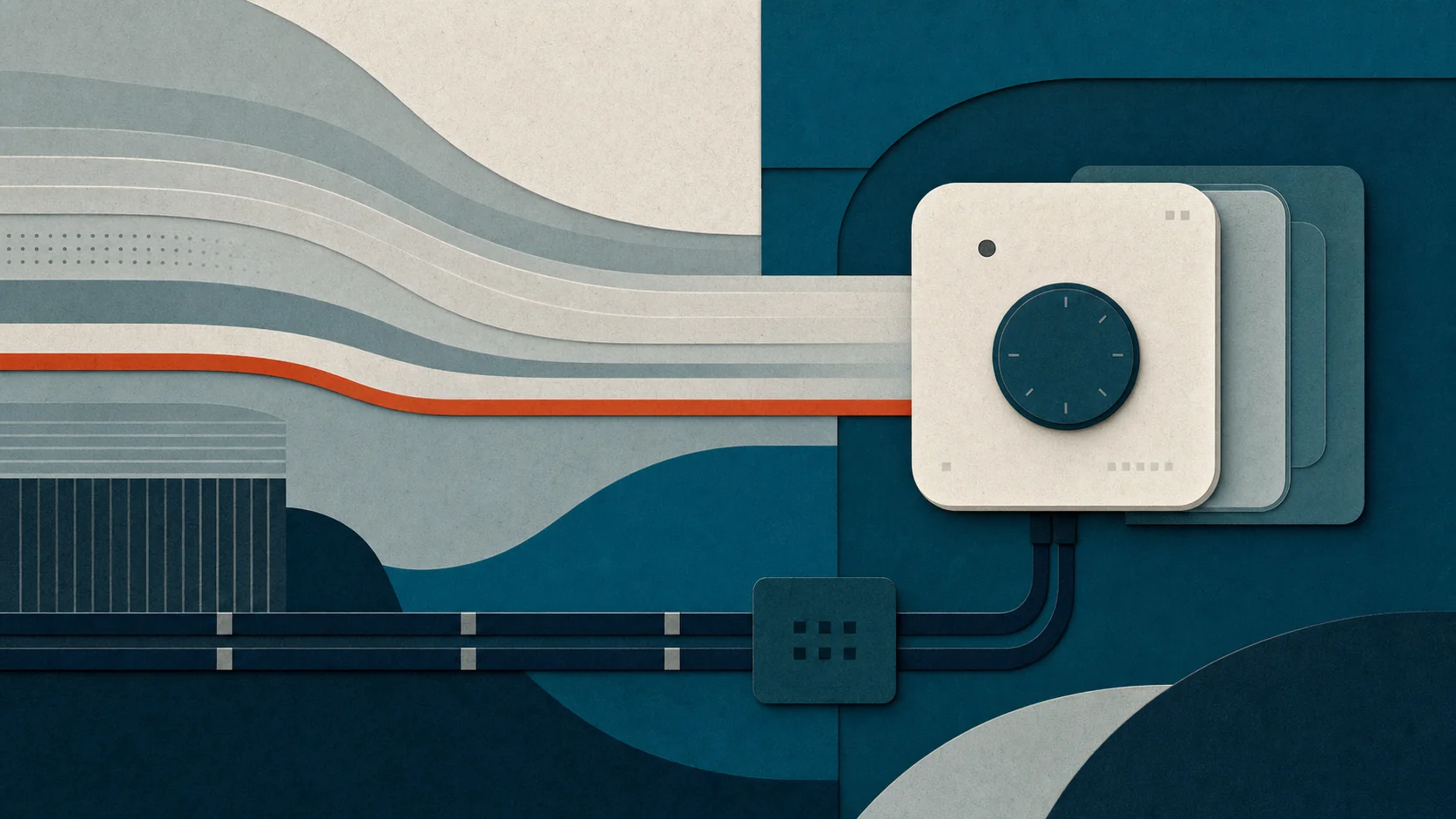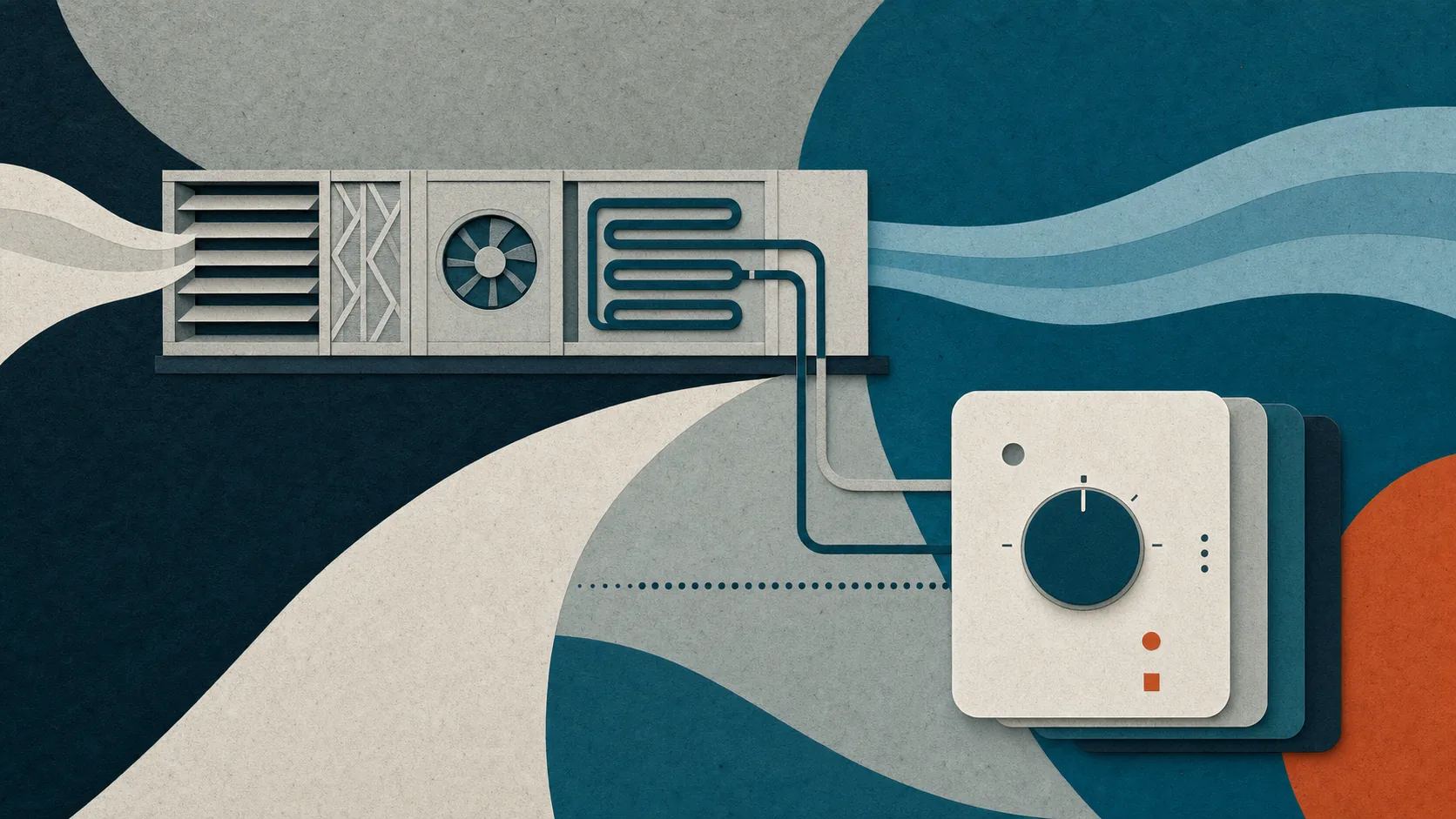
AHU and DX product managers do not need a Nest-style wall brick for a branded coil wall. An OEM AHU and DX thermostat puts 230 VAC relays, a Modbus citizen, and your glass on the same flush square — without assuming an EC fan path or an installer webshop SKU.
White LabelOEMHVACHeat PumpTemperatureFCU
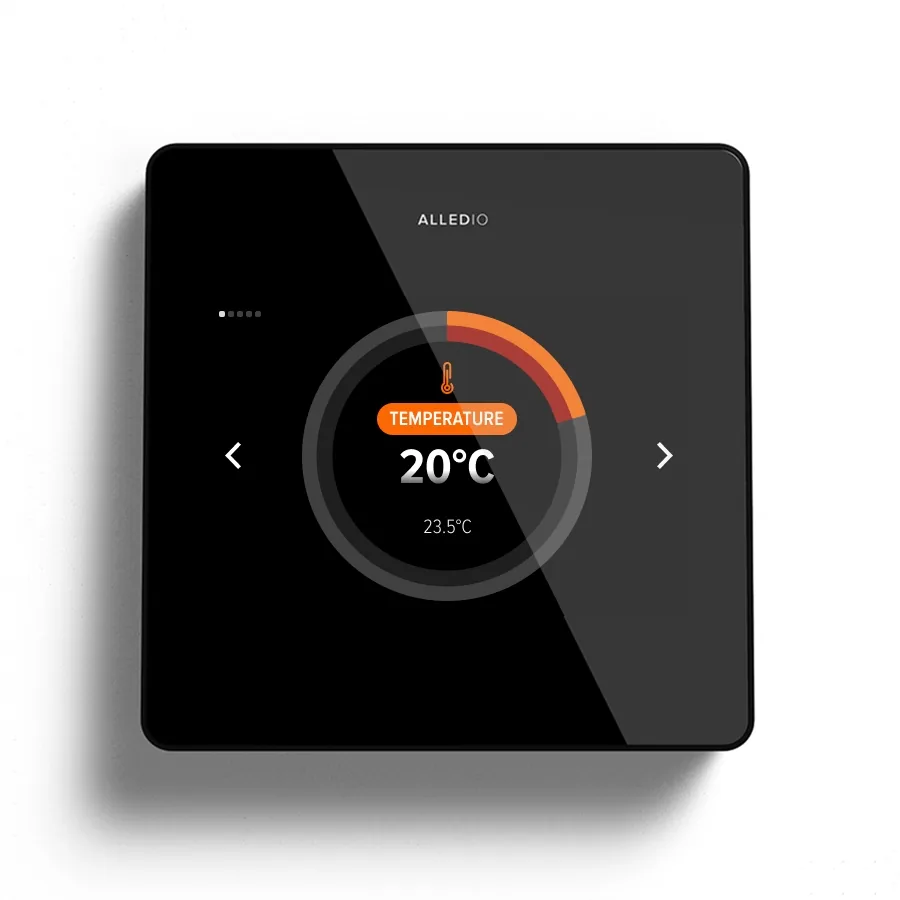
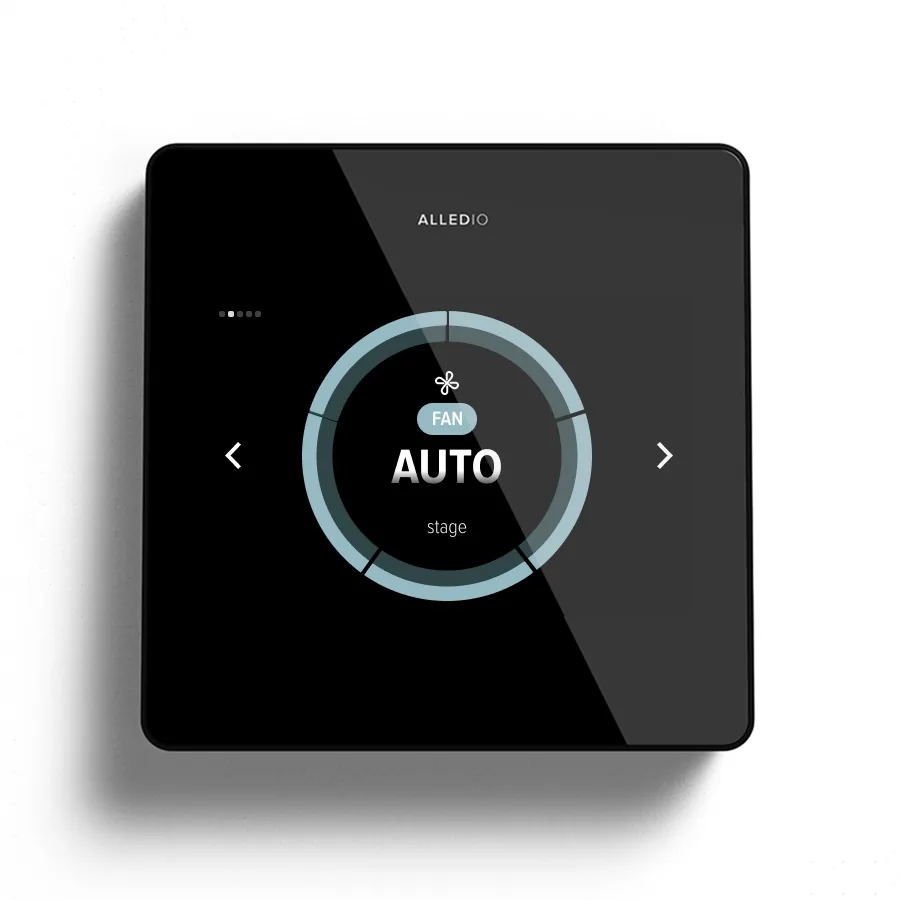
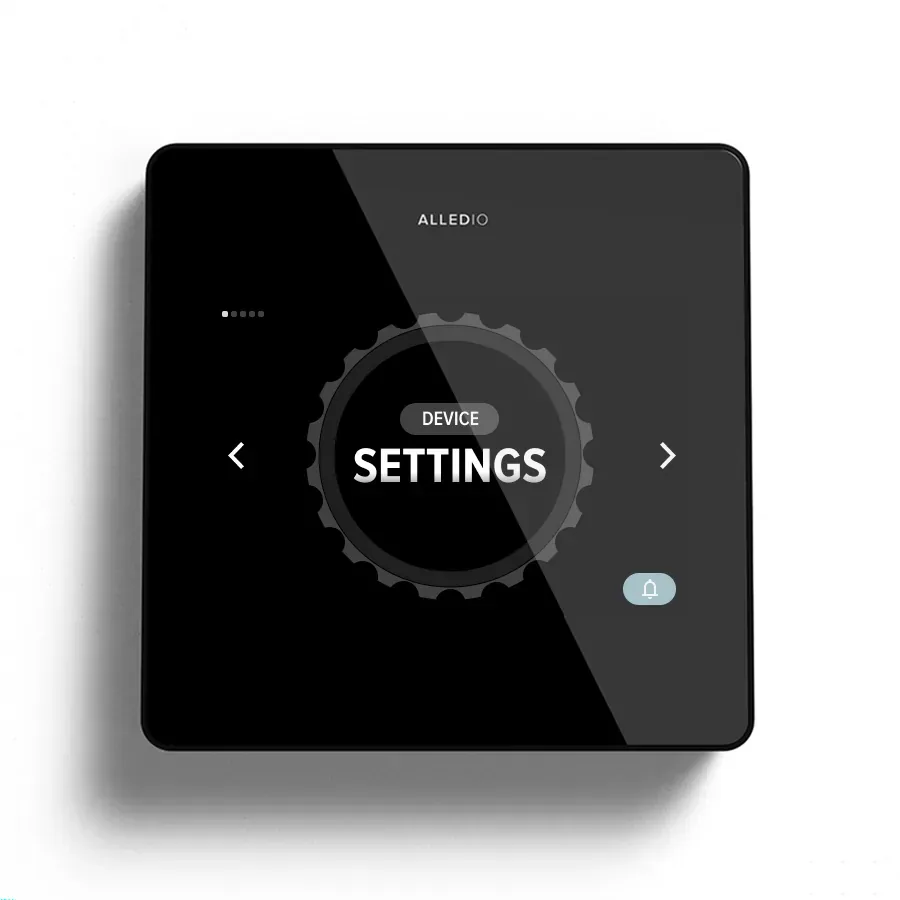
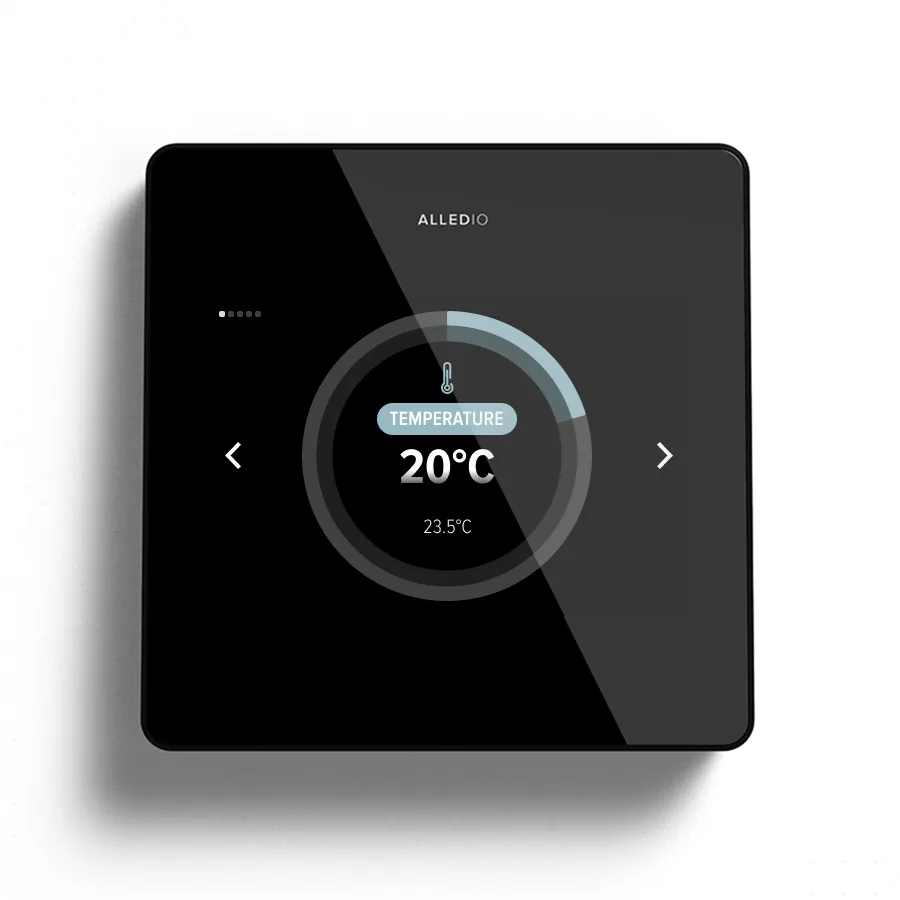
Alledio’s OEM Thermostat is that class of device. It is designed in Slovenia and manufactured in the EU. Relays switch heat or cool and the three-speed fan. The glass, the sensors, and the bus are the brand face the occupant sees.

Who this is for
This article is for AHU and DX product managers, heat-pump and FCU brand owners, and BMS device makers who need a branded relay thermostat at production volume, not a one-off installer SKU.
Typical applications on the product page are fan coil units, air handling units, DX equipment, and other local HVAC systems that need relay outputs. Installers and system integrators cannot buy Alledio direct. The commercial model is high-MOQ OEM. The usual MOQ is 1,000 pcs, and it is negotiable.
This is not a full AHU application controller in the wall. Sequences and safeties stay on your plant controller. The thermostat is the local face and the contact schedule. If you need a low-voltage host-driven UI instead, that is the Room Unit. If you need more standalone I/O in the same family, that is the Room Controller.
Bring the AHU or DX controls engineer into the same call as industrial design. One team owns the glass. The other owns the contact schedule. When those two briefs are written as one RFQ, NRE stays on logo and UI instead of a second electronics spin. That is the practical meaning of an OEM programme.
Write the documents you want back: ICD, register list, mechanical drawing, and a short integration note for the coil team. Name who approves artwork and who signs the Modbus map. Commissioning should not invent a field dialect on site.
DX vs FCU on the same OEM thermostat platform
DX and FCU walls often share the same commercial ask: a white-label glass, 230 VAC relays for heat or cool, and a three-speed fan path. The difference is plant context, not a second catalogue family. Write DX compressor interlocks and AHU safeties on the host controller, not as invented wall logic.
A white label FCU thermostat RFQ and an AHU/DX RFQ can share logo, UI chrome, and Modbus map language. Keep fan type explicit: three-speed relays. Do not paste a 0–10 V EC fan line into this RFQ unless you quoted a different model.
Optional IAQ add-ons (VOC, CO2) sit on the thermostat when you need room air quality on the glass. For enthalpy or multi-point AHU sensing, pair the wall with the Multi-Sensor and keep the maths on the host — see also why enthalpy matters in AHUs.

When a relay thermostat fits AHU and DX lines
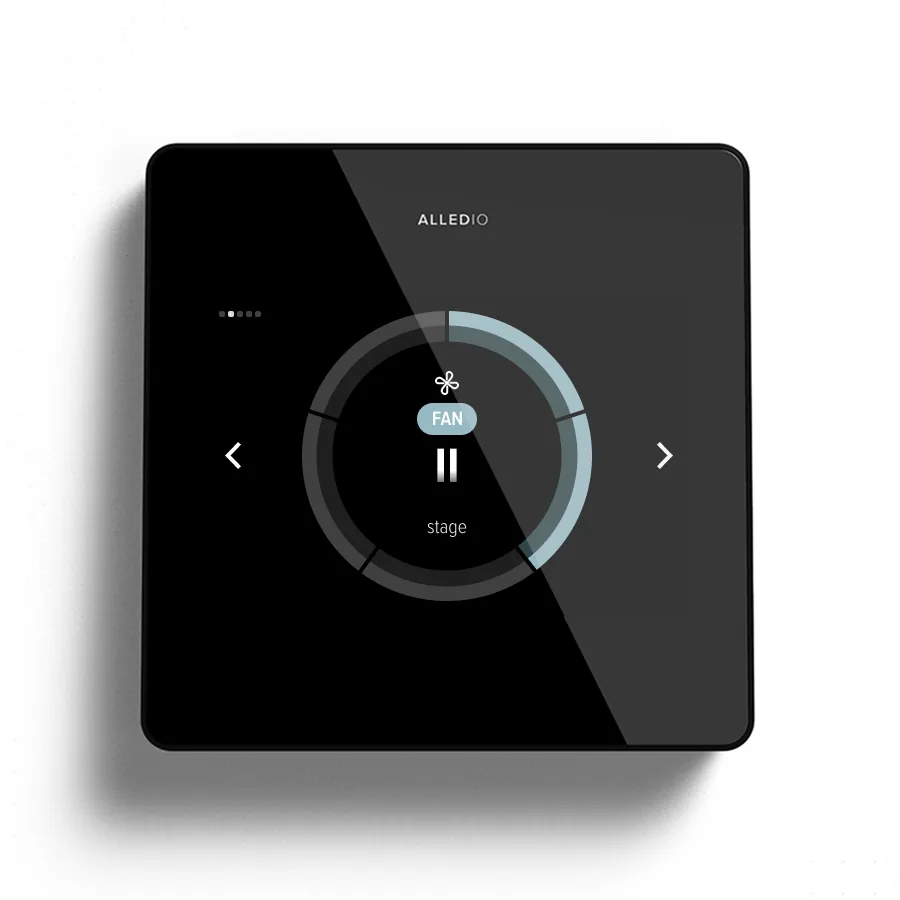
Write the RFQ around relays first. Speed 1, 2, 3, Auto, and off are contact closures. Heat and cool are contact closures. That is the published path for an OEM Modbus relay thermostat on AHU, DX, and FCU walls.
Modbus RTU on RS-485 is the supervisory copper pair. Baud, parity, address, and the register map belong in the same pack as the logo. Wi-Fi 2.4 GHz STA is listed for connected SKUs; MQTT is named for cloud or proprietary web services. That radio does not replace the copper pair.
Failsafe language belongs in the RFQ: what the relays do on bus loss, what the glass shows when the host is offline, and whether anti-freeze or a temporary fan boost is firmware NRE. Those are programme decisions, not catalogue surprises. Andivi will be at MCE Milano 2026 if you want that conversation in person.
Related reading for the same SKU family: OEM Modbus relay thermostat for FCU AHU. Use that piece when the RFQ is framed around Modbus first; use this piece when the plant is framed as AHU or DX.
When to use a Room Unit instead
Choose the Room Unit when the wall should stay low-voltage and host-driven, without 230 VAC relays on the glass. Choose this thermostat when the wall must switch fan speeds and heat/cool locally as contact closures. Do not blur the two SKUs in one RFQ sentence.
OEM customisation is the NRE path on both: exterior logo, UI colours, widgets, housing colourways, optional VOC and CO2, packing and docs. You pay for the delta, not for a new radio and a new mould.
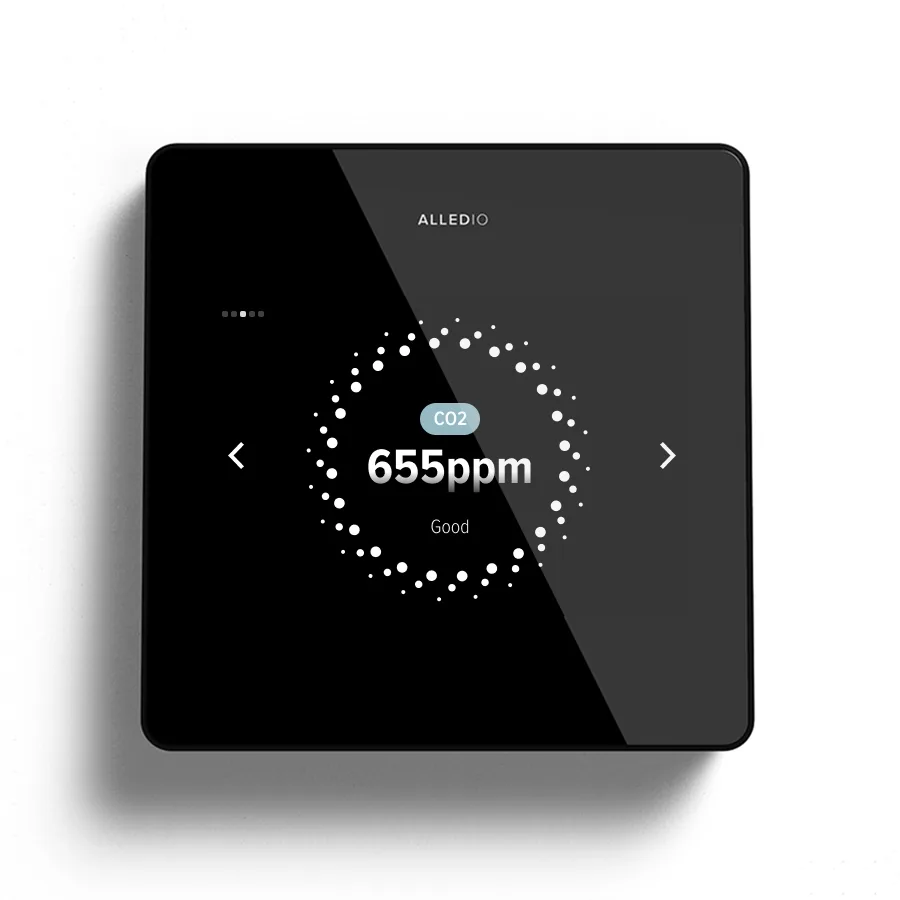
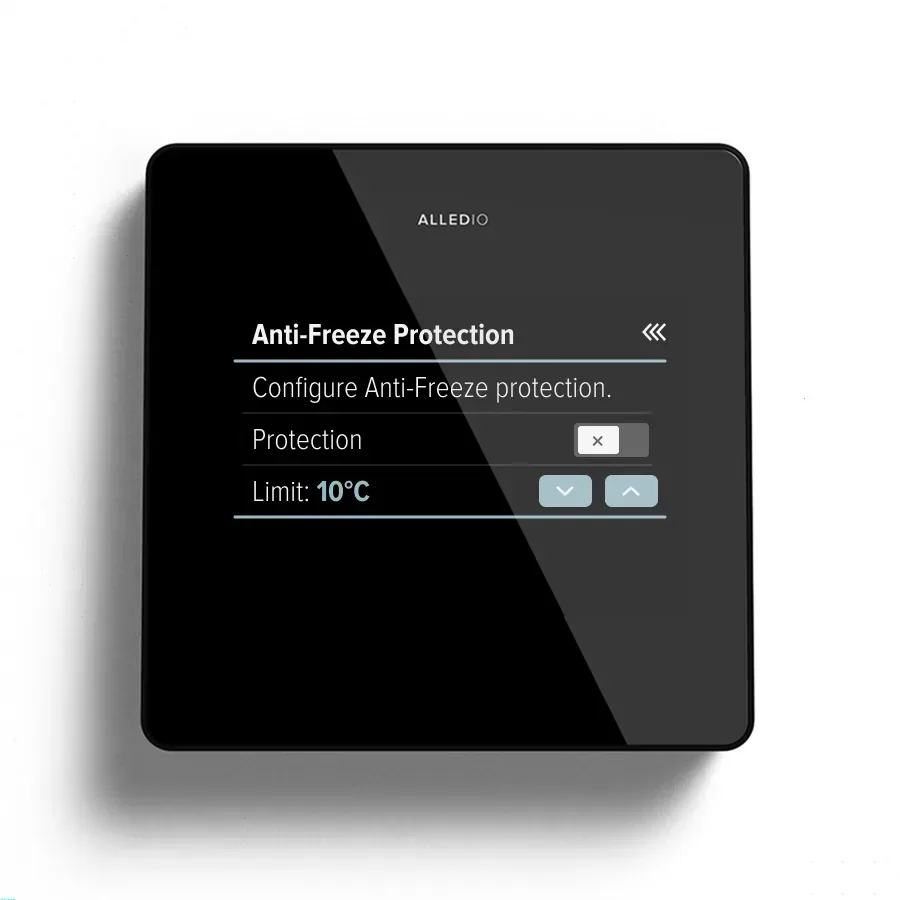
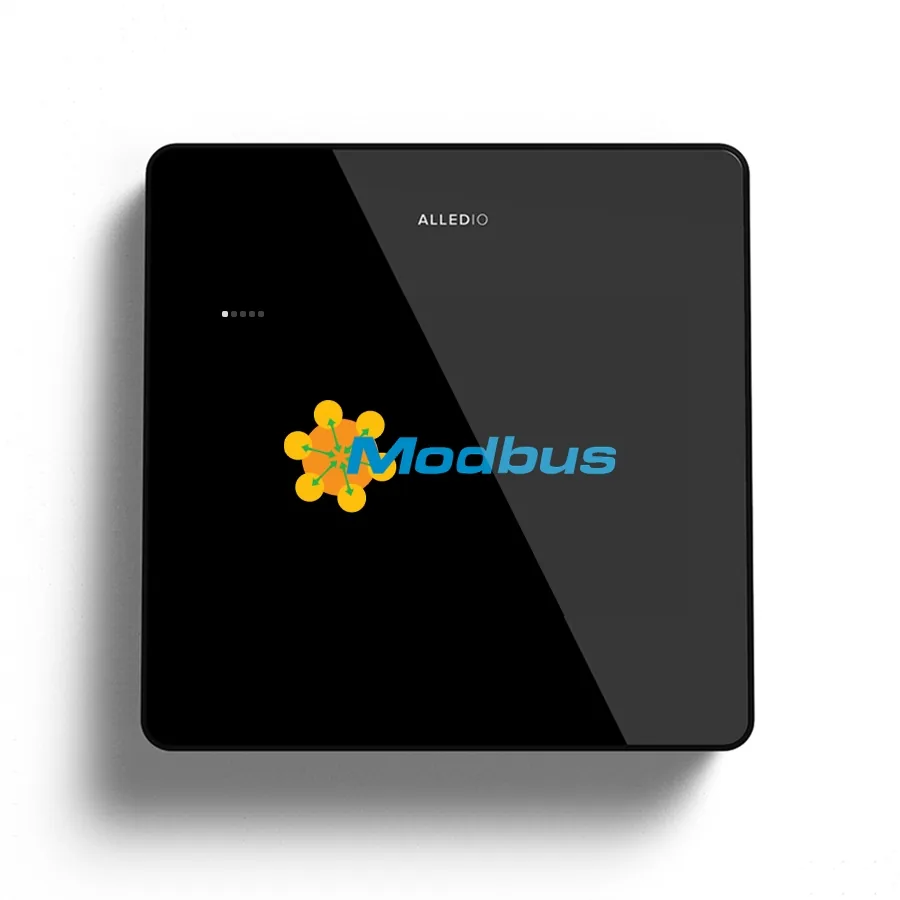
How the room feels, not only how the glass looks, is also the thread of Beyond design: it’s how it feels. Write brightness, night schedule, and absence behaviour as firmware requirements, not as afterthoughts.
Relays, I/O, and IAQ add-ons
Power on the thermostat page is 230 VAC. Mechanics you can defend today: 98 × 98 × 14 mm, 150 g, IP20, ABS plus scratch-resistant glass, flush-mounted in a standard EU box (Ø 60 mm). Display is 3.5" LCD at 480 × 320 with capacitive touch and a brightness sensor.
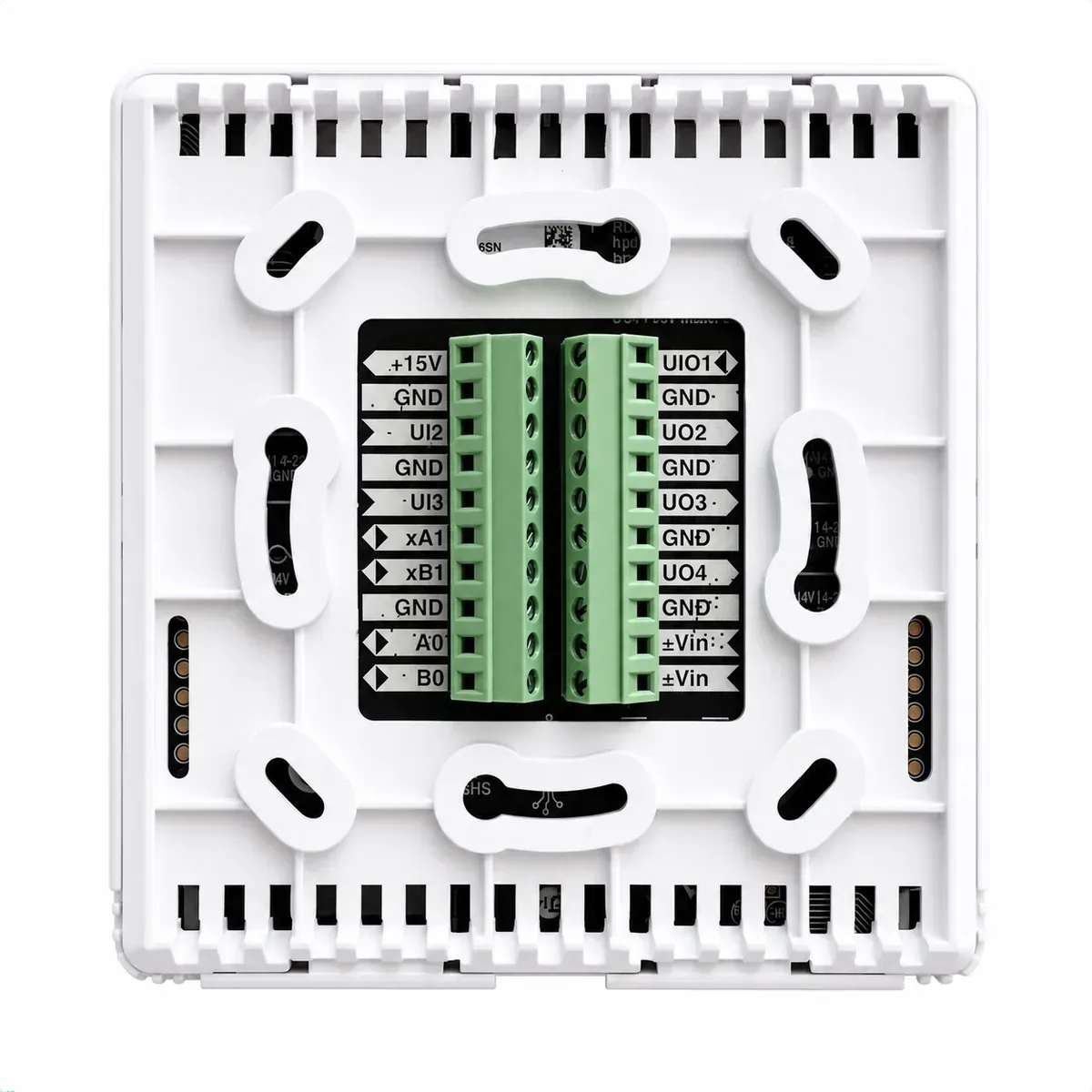
Four thermostat models are listed for I/O flexibility: 2 × AO, 2 × DO, 1 × AO plus 1 × DO, and 2 × relay heat/cool, on top of power, Modbus, and the fan-speed relays. Those analogue and digital options are models. They are not a licence to write EC fan control into the RFQ.
Not a catalogue SKU here: KNX. Other buses are OEM firmware or hardware work, quoted separately. Do not write a Nest-style retail part number into this RFQ. Enthalpy control for an AHU is not a wall-app feature — keep it on the host with Multi-Sensor inputs when you need it.
Name the sample count you need under NDA and whether demo firmware or test firmware is required for the first bench. Write who owns the artwork and who owns the register map. Those two owners should sign the same RFQ so NRE does not split into two silent projects. That is how OEM programmes stay honest on MOQ.
Do not promise an installer webshop, a Nest-style retail box, or a catalogue KNX SKU in the same sentence as this thermostat. Alledio sells to OEMs. Your channel sells to installers. Keep that split as a commercial rule.
Product proof
| Topic | Published spec |
|---|---|
| Product | Alledio OEM Thermostat (Modbus / relay) |
| Power | 230 VAC |
| Fan relays | Speed 1 / 2 / 3 / Auto / off |
| H/C relays | Heating / cooling |
| Display | 3.5" LCD, 480 × 320, capacitive touch, auto brightness |
| Sensors (standard) | Digital temperature and humidity |
| Sensors (optional) | VOC, CO2, external NTC |
| Bus | RS-485 Modbus RTU, half-duplex |
| Wi-Fi | 2.4 GHz (802.11 b/g/n) STA |
| Mechanics | 98 × 98 × 14 mm, 150 g, IP20, EU flush box Ø 60 mm |
| Origin | Designed Slovenia, manufactured EU |
| Standards | CE, EN 60730-1, EN 60730-2-9, EN 300 328 V2.2.2 |
| Security support | 5-year update window |
Use this table in the brand pack, then attach your logo and UI screens separately. Current and power-consumption cells are unpublished on the product page; leave them empty until the datasheet is current.
FAQ
Can an installer buy this from a webshop?
No. Alledio sells to OEMs. Installers and SIs get devices through your channel.
Is this a full AHU application in the wall?
No. Relays switch fan and heat/cool. Sequences and safeties that belong on your AHU or DX controller stay there unless you quoted the Room Controller.
Can we do enthalpy on the thermostat alone?
No. Pair a Multi-Sensor for the inputs and keep enthalpy maths on the host.
Can branding be white-label?
Yes. Logo, UI colours, widgets, and housing colourways are the usual OEM NRE surfaces.
Can we get samples?
Yes. Samples are available with demo firmware or test firmware, under NDA. This is not a webshop SKU. Start on /oem.
What is the MOQ?
The usual MOQ is 1,000 pcs, and it is negotiable. If you order several different versions of Room Unit or Room Controller and the combined quantity is over 1,000 pcs, we can go down to 500 on a version.
What to do next
Start on the Alledio OEM Thermostat page, then open an OEM conversation for logo, UI, firmware and samples. Bring plant type (AHU, DX, or FCU), fan type (three-speed relays, not assumed EC), 230 VAC, Modbus map, MOQ, and the artwork for the glass. That is how an OEM AHU and DX thermostat becomes a branded SKU instead of a sticker.