
When an RFQ asks for a bacnet vs modbus wall sensor decision, the buyer is not shopping a retail thermostat. HVAC and BMS OEMs need one wall node that measures the room, speaks the bus the estate already runs, and ships under their brand at programme volume. This compare walks that choice on the Alledio Multi-Sensor platform: ANM for Modbus RS-485, ANB for Modbus plus BACnet MS/TP and BACnet IP, same 87 × 87 mm housing, EU-made in Slovenia for OEM programmes only.
OEMBACnetModbusIAQBMSWhite Label

What the RFQ is really asking
Most briefs that land as bacnet vs modbus wall sensor are really three questions in one. Which fieldbus does the BMS already trust? Which room values must appear as native points without a gateway? And can the same hardware SKU cover both protocols when estates are mixed?
Write those answers into the RFQ before colour or logo. Protocol choice locks the product code — ANM or ANB — and decides whether BACnet objects or Modbus registers are the acceptance test your lab will run on the first samples.
Alledio sells OEM-only. There is no webshop and no installer catalogue price. Samples are purchased, ship with demo or test firmware, and NDA is available on request through the OEM programme. MOQ starts at 1,000 pcs and is negotiable per programme.
Expect the RFQ to name the sensing set as well as the bus. Temperature and humidity are the baseline; CO2 and VOC drive demand-controlled ventilation; pressure feeds psychrometrics; presence supports occupancy strategies. Listing those values up front stops a late change from TH to THPVCP after tooling and packaging art are already frozen.
Host, wall node, and I/O split
A wall sensor is not a plant controller. The Multi-Sensor measures and publishes; sequences, safeties and setpoints stay on the OEM controller or BMS. That split keeps certification and application logic where your team already owns them.
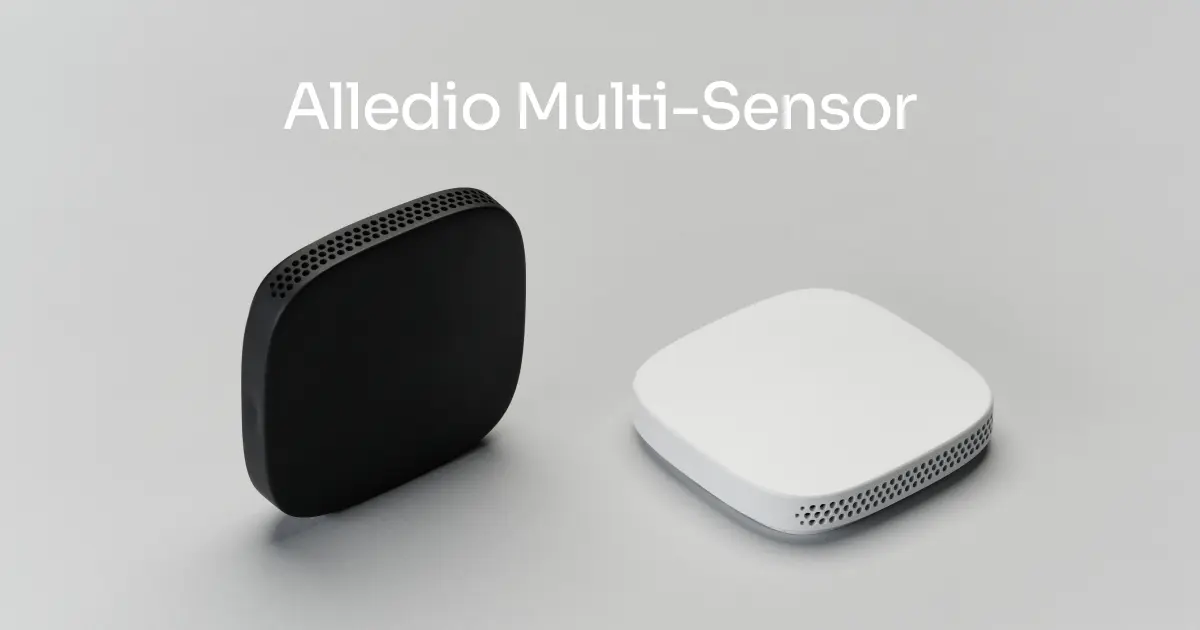
Power is 24 VAC (max 1.5 VA) or 12–42 V DC (max about 1.1 W). The housing is 87 × 87 × 19 mm, 55 g, flame-resistant ABS, IP30, for −10 °C to +50 °C and up to 85 % RH non-condensing. Mount at about 1.5 m on an inside wall, away from direct supply air and fan-coil blow.


Variants scale from TH (temperature + humidity) up to THPVCP (pressure, VOC, CO2 and presence added). Computed dew point, enthalpy and density of moist air ride on temperature, humidity and pressure so an AHU or VAV controller gets psychrometric inputs without extra BMS maths — see why that matters in why enthalpy is relevant in AHUs.
Wiring is a short RS-485 trunk job: twisted pair with drain wire, unique address or Device ID per node, and termination at the ends of the segment. The Multi-Sensor exposes power and bus on the back plate; commission after the front is closed. There are no DIP switches — NFC opens a local web app within about 2 m for parameter entry, offsets and firmware update or rollback.
Protocols Alledio actually ships
ANM reports measured and computed values on Modbus RS-485 (address 1–247, baud 4800–115200, RTU or ASCII, software termination). ANB keeps that Modbus path and adds BACnet MS/TP on RS-485 plus BACnet IP over STA Wi-Fi. Communication mode is chosen at commissioning, so one ANB SKU covers both BACnet trunks.
| Topic | ANM (Modbus) | ANB (BACnet + Modbus) |
|---|---|---|
| Fieldbus | Modbus RS-485 | Modbus RS-485 · BACnet MS/TP · BACnet IP |
| Sensing platform | Same TH…THPVCP / P family | Same TH…THPVCP / P family |
| Computed values | Dew point, enthalpy, density (variant-dependent) | Same, as BACnet AV objects |
| Commissioning | NFC + local web app | NFC + local web app (MS/TP, IP, Modbus) |
| Typical estate | Modbus BMS, HVAC OEM trunks | BACnet buildings, mixed protocol estates |
| Not claimed | BTL / KNX catalogue SKU | BTL / KNX catalogue SKU |
On ANB, BACnet objects are fixed and readable: AI 0–5 for temperature, humidity, VOC, VOC Index, CO2 and pressure; AV 0–2 for dew point, enthalpy and density; BI 0 for presence. Unfitted elements report Out_Of_Service = True instead of fake zeros. Confirm object mapping and COV increments against the current datasheet before you freeze the RFQ — do not invent a BTL listing.
For MS/TP, set Device ID, MAC and Max Master to the highest MAC on the trunk; baud is selectable up to 115200 with optional 120 Ω termination. For BACnet IP, agree the building SSID, password and UDP port (default 47808) with IT before the first floor is installed. Wi-Fi is off as shipped and only enabled when the installer turns STA on.
External references for the protocols themselves: bacnet.org and modbus.org. For a deeper BACnet IAQ walkthrough on the same hardware, see OEM BACnet wall multi-sensor IAQ.
Wall sensor vs room unit OEM
Buyers often blur a sensing node with a room UI. Keep the split explicit. A Multi-Sensor has no display and no setpoint glass; it is a wall transmitter. A Room Unit is the 3.5" capacitive glass for setpoints and status, host-driven over Modbus, without native BACnet in the published catalogue.
Pick Multi-Sensor when the BMS needs IAQ and psychrometrics as bus points. Pick Room Unit when occupants need a branded touch UI. Pair them on the same trunk when both jobs exist in one zone, and keep plant logic on the OEM host either way.
If the wall must also drive valves or a fan from universal I/O, that is the Room Controller path — a different product brief, not a Multi-Sensor option. Thermostat covers 230 VAC relay fan-coil packages. Do not force BACnet onto Room Unit or Thermostat catalogue lines; use ANB when native BACnet is mandatory.
A practical RFQ line therefore names the wall job in one sentence: sensing-only Multi-Sensor, UI-only Room Unit, or controller with I/O. Mixing those jobs into one vague 'wall device' line is how projects buy the wrong SKU and discover it at sample test.
Where each protocol wins on site
Modbus remains the default on many HVAC OEM packages because the plant controller already speaks it and the register map is short. ANM fits that world: one RS-485 trunk, slave addressing, and the same sensing family you will later brand. Labs can prove the map with a free browser master before the production firmware is locked.
BACnet wins when the building standard or the BMS tender demands native objects, COV and discovery without a protocol gateway. ANB answers that brief on the same wall footprint, and still keeps Modbus available for mixed estates or OEM test benches. Choose ANB early if any target market writes BACnet MS/TP or IP into the specification.
Do not treat the compare as a feature race. Both lines share housing, NFC commissioning, computed psychrometrics and EU origin. The decision is which bus the host expects to see on day one — and whether one SKU must cover both buses across a portfolio.
Branding, MOQ, NRE and samples
Finish options include bright white and blurred black. OEM programmes cover logo, packaging, protocol defaults and firmware. Larger programmes can scope further sensing through hardware and software development, validated on the protocols you already ship.
Commercial terms stay OEM-capped: MOQ 1,000 pcs, negotiable; samples purchased with demo or test firmware; NDA on request via /oem. The platform was shown to HVAC buyers at Refrigera 2025. Compliance starts from RED 2014/53/EU and RoHS; ask for the EU Declaration of Conformity with the sample.
Plan the sample phase as a lab gate, not a favour. Power the node, run the 30–45 minute auto-calibration, set offsets against a reference instrument, then confirm Modbus registers or BACnet objects and COV. Only after that gate should branding, packaging and production NRE move forward — that is how OEMs avoid respin cost later.
FAQ
Can an installer buy one wall sensor from a webshop?
No. Alledio sells OEM-only. Installers and integrators receive devices through the OEM brand that specifies them.
Does the wall sensor run the plant?
No. Multi-Sensor is sensing plus computed psychrometrics. Control sequences stay in the BMS or your OEM controller.
Is there a KNX SKU or a BTL listing?
No KNX catalogue SKU is published, and a BTL listing is not claimed. Confirm protocol documentation in the RFQ if your tender requires it.
What is the MOQ, and can we get samples?
MOQ starts at 1,000 pcs and is negotiable. Samples are purchased and ship with demo or test firmware so your lab can check discovery, objects or registers before production branding is locked.
How do we choose ANM vs ANB?
Choose ANM when the estate is Modbus-only. Choose ANB when you need BACnet MS/TP or BACnet IP on the same sensing platform, with Modbus still available.
How is the device commissioned?
Tap a phone on the NFC tag. A local web app over a short-range Wi-Fi AP sets Modbus or BACnet parameters, offsets and firmware update or rollback. Allow 30–45 minutes for first-power auto-calibration before setting offsets.
What to do next
Open the Alledio Multi-Sensor page, decide ANM or ANB from the trunk plan, then start an OEM conversation or contact for samples with demo firmware, NDA and a quote. Bring the zone list, protocol choice, Device ID or slave range, finish and target volume — that is the shortest path from a bacnet vs modbus wall sensor RFQ line to a branded node on your customers' walls.